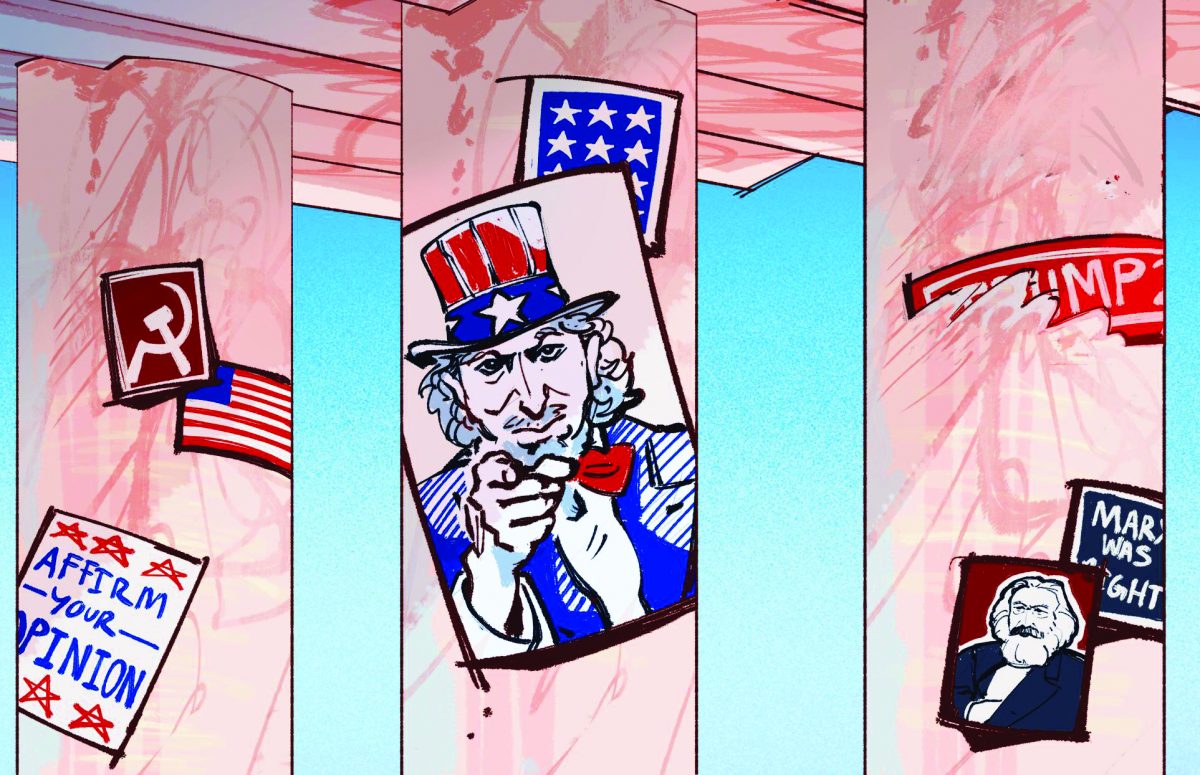
Student political organizations on the UTD campus, like Turning Point USA and the Revolutionary Communists of America, haven’t been doing their jobs very well. While the role of any campus organization is inherently subjective, this discussion evaluates these groups based on their ability to increase student political engagement and foster meaningful discussion.
TPUSA is one of the most known political student organizations on campus and often tables with large whiteboards featuring political questions to start discussions and gauge student perspectives.
While community engagement is important on college campuses, TPUSA’s approach is one of the least effective. One of its only consistent public-facing efforts — a vaguely controversial question displayed on large whiteboards every couple of weeks — is unlikely to foster meaningful dialogue or accomplish much.
The same applies to RCA, which occasionally tables near the Plinth. You may have seen their red stickers on lampposts across campus, which do little to spark discussion because they lack depth.
Despite their presence on campus, the UTD chapters of these organizations don’t tend to have a large membership of students.
They often push their audience to take a side rather than engage in meaningful discussion. At a TPUSA booth set up a while back, a large board was displayed titled “Tally if you are in support of X policy position,” which was generally understood as an incredibly right-wing take.
Although this may seem like a way to gauge public opinion, it does little to contribute to meaningful campus discussion and instead becomes a public display of division around issues like immigration.
The practicality surrounding the whiteboard seemed like another issue, too. With students bustling and busy all around campus, simply having someone draw a tally with an Expo marker on a whiteboard to convey a policy position and then leave does little in the long run and may leave students with opposing views feeling frustrated.
TPUSA marketing is largely built on using inflammatory statements to trigger emotional reactions from liberal students. Oftentimes, such marketing is seen as intellectually dishonest to the purpose of political organizations as they claim to come onto college campuses to engage in “real discussion.” These actions and responses build a narrative that the “other side” is violent, irrational and trying to silence conservative voices on campus — when in reality TPUSA’s approach is just terrible.
The RCA is equally inefficient with its marketing. Its messaging features flashy posters of Luigi Mangione, charged with second-degree murder in the high-profile case involving UnitedHealthcare CEO Brian Thompson. Alongside Mangione, they display images of Vladimir Lenin, a historical figure associated with mass political violence, including de-Cossackization, the Red Terror and the famine of 1921–22.
If the goal is to advertise your ideology to college students, you shouldn’t prop up a person charged with second-degree murder or an infamous politician known for mass casualties as its mascot.
While members of the RCA likely do not intend to advocate for murder, they may be unintentionally associating themselves in the minds of students with a mass murderer, just because they wanted to market using a notable communist.
Both organizations have demonstrated they assume absolute audience agreement and fail to engage moderate opinions.
Here’s how these student political organizations can be more effective.
First, these organizations should focus more on attracting new members instead of only affirming their base. This doesn’t mean they need to abandon their beliefs, but they could frame them differently to inspire curiosity instead of anger.
Aside from the message itself, the way these communications are delivered could also be improved. Tabling is good for current members to chat with interested students, but doesn’t allow them to reach a wider audience.
Secondly, they could focus on things like pamphlets or larger posters instead of the stickers and pins these organizations often use. A pamphlet, for example, could be used to explain the political philosophy of these organizations in a way that is clearer and more nuanced than what is currently used.
The obvious flaw with printed materials is that they can be hard to create and distribute, and while it’s definitely possible to get value out of them, it may be more work than these organizations want, especially without any established infrastructure.
One obvious workaround is using existing infrastructure.
Campus-based media outlets, like The Mercury, offer members of the public the ability to submit an op-ed for publication. This is a useful venue for political organizations to speak to the campus at large.
Another outreach option involves social media. Through this platform, they could better promote their organizations, but its sole use overlooks the advantage of their physical proximity. Political thinkpieces are rampant online, but many Comets are starved of tangible interactions. With a mixed-media approach, these organizations could foster real discussion and benefit the larger student community.
At the end of the day, we are all Comets and we all want to see UTD become a more prosperous campus. That includes civil and political engagement, regardless of which side of the political aisle you align with.