Throughout my first semester on campus, I was convinced that UTD was pretty ugly.
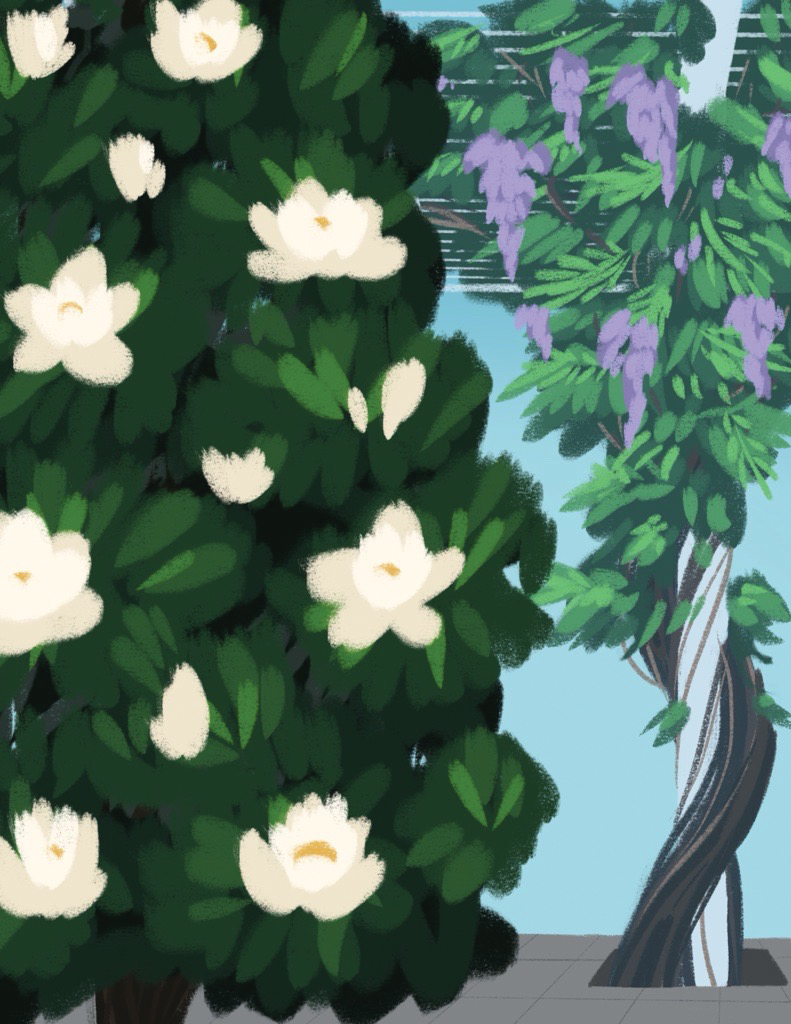
It is just a square mile of concrete, I thought, centered around a mist fountain that never turns on. Then, I returned from winter break, and I saw something miraculous. The wisteria covering the trellis around the Plinth — that I had thought were just dead roots — bloomed to life.
This completely changed how I thought about campus, and I began to look at the rest of the environment here with new eyes. Take, for example, the rows of magnolia trees that grow south of the Plinth. I always saw the trees as decorative, but imagine how that part of campus would look without them. It would be two sun-baked sidewalks with a little bit of water in between. According to an article from the Office of Sustainability here on campus, that area used to be called the “Concrete Canyon” before the redesign to introduce the magnolias and fountains.
These two examples are what taught me that the plants on campus actually matter, but some light research shows that they are useful for more than just looks. A 2019 study from Texas A&M by Charles Hall and Melinda Knuth shows that time spent in green spaces can help reduce stress, depression symptoms and anxiety. For Comets like myself who are struggling to get through exam season, this could be a major help.
But as of right now, those two examples I gave — the wisteria and magnolias — are some of the only notable plants on campus. We have a few truly green spaces, but they are few and far between. For the most part, UTD can still very accurately be called a “Concrete Canyon.”
Part of this is endemic to the way the university functions. A commuter school like our own needs a lot of parking, so we have gigantic parking lots throughout the area taking up space. Many of the main buildings on campus are crammed in close together, leaving room for a sidewalk and almost nothing else.
And even what plants we do have already provide us with so much. The complex web of roots they create keeps the nice little hills all around campus from eroding away and washing into the streets every time it rains by controlling erosion.
Plus, the plants keep all the little critters on campus around, which is one of the few things that keeps our campus from feeling as sterile as it really is. Those cute woodland critters do not grow on trees, so we should all be thankful that their food does.
And that thankfulness, that gratitude, is maybe one of the most important reasons for the university to invest in this issue, despite the challenges. I think I have shown already just how much the plants on campus do for us, and neglecting that could be ruinous.
I worry that ignoring the plants that provide those benefits will lead to a lack of appreciation for the environment among people that study here at UTD, and for how messed up our climate already is as a result of people who never cared about the environment, we cannot afford that.
Even despite all of this doomsaying, though, there are a few bright spots of hope for UTD’s future.
There are a tiny number of spots around campus labeled as Wildflower Areas, or Pollinator Areas, where only native Texas plants and wildflowers are grown. This could easily be expanded to some other areas around campus — perhaps the large empty lot between the Administration and Science buildings — so that we grow more than just grass, grow things that are evolved to live on the meager amount of water we get from rain.
If policies like these are implemented and expanded, one day we all might live on a campus that is more green than gray, and get to experience the many benefits that will come with it.