

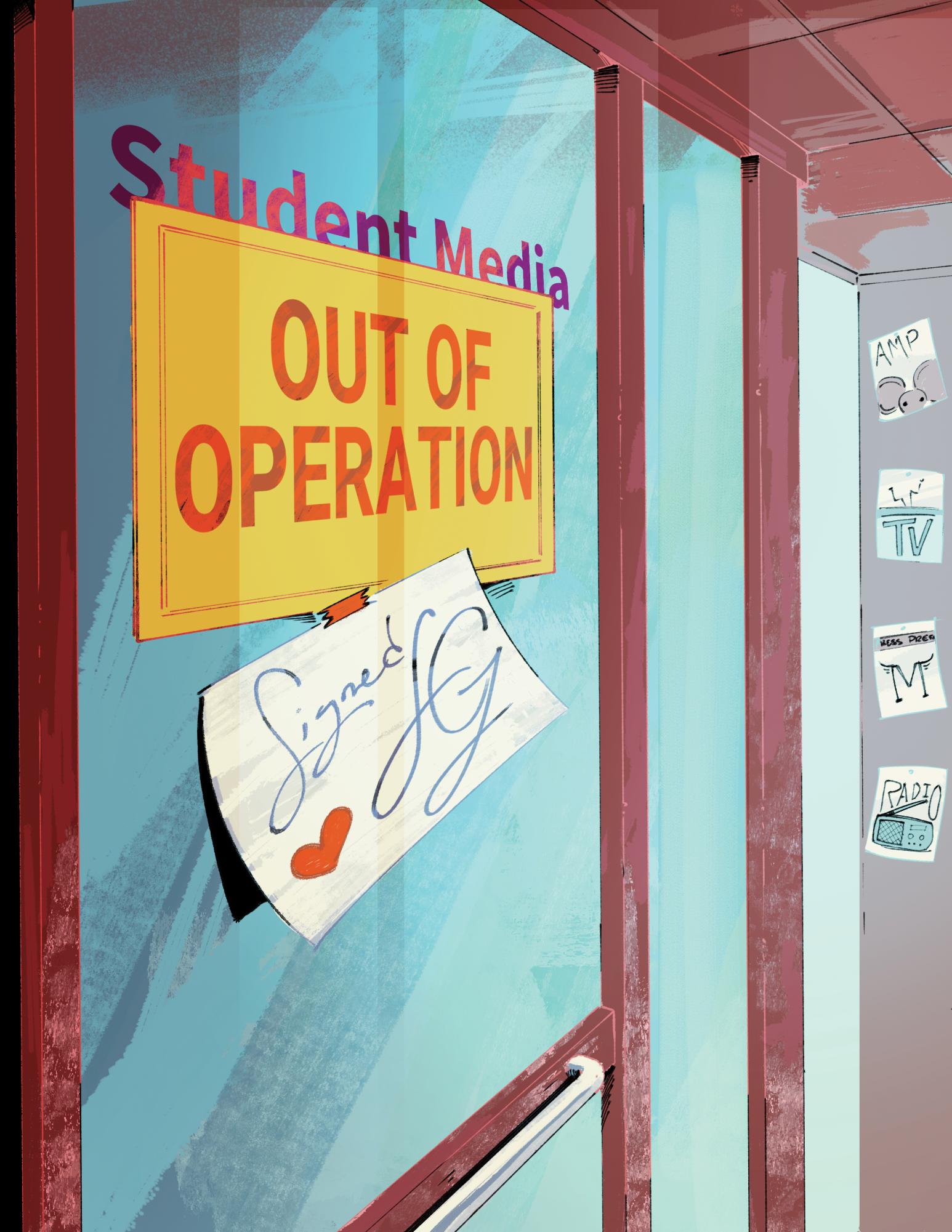
When I began as editor in chief of The Mercury, I was told that administration would be my biggest adversary. We entered the year expecting attempts to silence us. What I didn’t expect, however, was to face that opposition from fellow students.
On April 3, the Committee on Student Media (COSM) was scheduled to interview candidates for The Mercury’s editor in chief and managing editor positions. We expected to receive decisions later that day.
Instead, after sitting in the lobby for half an hour, none of us were interviewed.
Student Media has struggled this year to secure fair representation on COSM, the committee responsible for overseeing general operations, mediating disputes and appointing the head leadership for all four outlets, with terms beginning May 1.
In the February issue of The Mercury, I expressed concern over Student Government-appointed COSM members that were employed by a competing publication. Those members were removed by COSM during the Feb. 20 meeting.
Two new undergraduate appointees from Student Government were selected in time to move the appointment process forward. With those changes, I expected a functional interview process and prepared to defend the position I have held for nearly a year.
During the April 3 meeting, Chairman McClain Watson was about to invite the first candidate to begin interviews when concerns were raised by the new appointees. They stated that the candidates for The Mercury did not meet a bylaw requiring the editor in chief and managing editor to have at least one byline in four separate issues during the semester of appointment.
Director of Student Media Karen Fioretti clarified that the students would meet these qualifications by April 20, when the fourth issue of the semester is published.
Fioretti then made a motion to make any potential Mercury appointments to proceed conditional on meeting that requirement. The motion passed 6-1-1.
A subsequent motion to table, or set aside, bylaw discussions until after new leaders were appointed passed 6-2.
However, as interviews were about to begin, the two Student Government appointees left the conference room, breaking quorum and cancelling interviews entirely. This followed notice from another Student Government undergraduate, given just hours prior, that they would not be in attendance. Without the required number of student COSM members present, COSM could not proceed with interviews.
This left The Mercury without confirmed leadership for the next year.
If you’ve chosen to participate on a committee, why refuse to sit through the very meeting you’re responsible for?
Emails obtained by The Mercury show that these members do not plan to participate in the rescheduled April 24 interviews unless COSM passes a motion to revise the bylaws over the summer in consultation with third-party experts.
To be clear, I believe that some bylaw revisions are necessary. I intend to propose changes this summer, as I did last year, if reappointed as editor in chief.
However, it is not fair to take actions that effectively hold Student Media employees’ jobs and paychecks hostage until one’s demands are met.
This final round of interviews comes just before current leadership terms end on April 30, leaving little room for delay. It is unclear if the undergraduate COSM vice chair will attend after missing the last meeting.
However, one critical difference sets the April 24 interviews apart.
All of the Student Media leadership is scheduled to be interviewed.
Not just The Mercury, but all of Student Media. This includes AMP, Radio UTD and UTD TV.
Communications from Student Government raise further concerns about how these decisions are being applied. In an email after the April 3 meeting, the Student Government president wrote that the Student Government COSM appointees “remain open to attending and observing the interview processes for AMP, UTD TV, and Radio UTD,” notably excluding The Mercury.
This contrasts with a more recent email from a member who walked out, in which she expressed bylaw concerns for all outlets. All Student Media organizations operate under the same bylaws. If those concerns were truly universal, participation, or lack thereof, would be consistent across all outlets.
If the bylaws are the issue, they apply uniformly to all Student Media outlets. Choosing to walk out of The Mercury’s interviews while remaining willing to participate in the others tells me that standards here aren’t being applied fairly.
If no leaders are appointed before May 1, over 80 students employed by these outlets will be out of a job, as the leadership elected by COSM is responsible for choosing their own staff.
Many students rely on their stipends and contributor pay to afford rent, groceries and other necessities. Others have found purpose creating content they love and are passionate about in Student Media.
Failing to appoint leadership effectively shuts down all four official Student Media outlets.
Actions that prevent Student Media from functioning contradict the principles of free expression. These actions are especially concerning, coming from members of our own Student Government.
This is also a weaponization of voting power. If members can break quorum or block decisions they disagree with, any future committee can be rendered ineffective at will. In this committee, the majority rules, unless the minority decides to shut it down.
Student Government is supposed to govern and protect the rights of all students, yet repeated actions by its appointees have destabilized Student Media.
For our Mercury readers, this uncertainty puts the May issue in jeopardy. As of right now, The Mercury has been unable to secure leadership for the upcoming year. We will continue to keep our community informed of any changes to our publication schedule.
This year has been challenging enough for its creative outlets as-is. Student Media doesn’t need its own Student Government taking actions that prevent its outlets from being able to function.
While there is little reason to believe this pattern will change, it remains critical to call it out and inform our community of actions that threaten the livelihood of Student Media.
Allison • Apr 25, 2026 at 11:29 am
I came from retrogrades post and idk much of what’s going on but this one is more demure
Hira • Apr 25, 2026 at 9:26 am
Who else came from reddit
ally • Apr 24, 2026 at 8:02 am
this whole thing just feels so avoidable… like even if they had issues with the bylaws, why not stay, do the interviews, and then push for changes after
ally • Apr 23, 2026 at 10:48 pm
when the bylaws are never revised and merc gets fired again, someone screenshot this message and let us never forget the basic requests for review that have been asked for across over a year worth of meetings.
Willow • Apr 23, 2026 at 7:24 pm
Why hadn’t the Mercury been able to publish more than 3 articles by April 3rd? The Mercury from 2024 definitely did, and the Retrograde right now did! I will grant that the week of March 9th was an “exam period,” given that it was right before Spring Break. But the week of April 6th definitely was not. The specific bylaw violation was brought up in the article and I think this subject deserves a bit more interrogation in the piece.
I feel like you can’t make an argument that the Mercury student leadership deserves to keep their stipends when they, objectively, are being less productive than is the norm. If you’ve chosen to participate as the editor-in-chief of a newspaper, why refuse to publish the very paper you’re responsible for?
Jumang • Apr 23, 2026 at 8:30 pm
I think this is missing some context. The current Mercury staff basically had to restart the publication with a much smaller team compared to 2024, so it makes sense things would be slower at the beginning.
Comparing it to last year or to the Retrograde isn’t really fair when the situations are different. Rebuilding something takes time, and fewer articles early on doesn’t mean people aren’t doing work.
Also the stipend point feels kinda off. It’s not just about how many articles get published, there’s a lot that goes into getting everything running again.
Willow • Apr 23, 2026 at 9:25 pm
The Mercury staff did not “have” to restart anything; they could have offered their services to the Retrograde instead of joining Student Media. The UTD administration also wasn’t forced to restart the Mercury from scratch; they could have simply listened to the demands of the former Mercury staff after they went on strike and maintained continuity in the editorial team.
With this in mind, choosing to join the Mercury for either A) the potential stipend or B) the institutional prestige immediately, I feel, makes them substantially less deserving of leniency here. You have an obligation to publish according to the outlined schedule, because you are being paid by and working for the student population of UTD at large. If you are not capable of this, then you should not be choosing to manage a newspaper, and you should not be hired and rehired to manage a newspaper.
Jumang • Apr 23, 2026 at 10:48 pm
I feel like this is kinda ignoring a lot of context. Saying they “could’ve just joined the Retrograde” like that’s just an easy switch when it’s a different org thats already oversaturated. same thing with the stipend/prestige point. people can want to do journalism AND be able to afford college, why is that some shady motive. acting like getting paid automatically makes them less valid is weird.
and comparing them to groups that already had everything set up doesn’t really work either. they’re basically rebuilding something with way fewer people, of course output isn’t gonna match right away.
also it feels like this is drifting away from the actual issue in the article. it was about bylaws and process and whether things are being handled correctly, not just “why aren’t there more articles”. walking out of meetings and stuff affects that whole process
you can critique productivity sure, but this just sounds like ur mad students have an actual job.
rin • Apr 23, 2026 at 11:37 pm
people don’t want to be linked with the alleged $A
Manasi • Apr 24, 2026 at 10:00 am
If this is *anything* other than blatant disinformation, why are there only anonymous claims on Reddit, Retrograde, and Mercury comments that this happened? Why has it only started now that Retrograde has shown they have more influence than UT Dallas’ official Student Media?
You’re clearly the same person as the one on Reddit making alts considering you use “$A” like you’re trying to avoid takedowns on TikTok. Call it what it is. Sexual assault. Retrograde posted information on how to report said allegations to them and UT Dallas on your threads. Now pony up and have an actual source give any sort of proof on your Reddit posts, or quit making baseless allegations.
You babying the term “sexual assault” and levying allegations with zero named victims, assailants, or evidence is rapidly causing the public to lose trust if these claims ever come to light.
Ally • Apr 23, 2026 at 1:05 pm
lol they removed the like feature bc the truthtellers were getting too many likes
The real gregrio • Apr 23, 2026 at 8:59 pm
“Truthtellers” bro, who do u think u are people who dont bend to Gregorios ‘ every wish are liars? gyatt bro
bain • Apr 24, 2026 at 3:49 am
wow u are actually delusional
Grant • Apr 22, 2026 at 6:47 pm
all of you need a time out
butterfingers • Apr 22, 2026 at 4:29 pm
this is such a messy situation all around. I understand the concerns about bylaws and ensuring things are done correctly, but walking out and stopping the process completely makes things worse for everyone. It also makes me doubt this was actually done for the sake of “bylaws”, seems sketch. at the same time, and there are some real structural issues that should be addressed, which would genuinely help the students, so it should be made into a thing. it just sucks that it’s happening in a way that could affect so many students’ jobs
Zayne • Apr 22, 2026 at 3:20 pm
genuine question, if you run for a committee position and then just don’t show up to the meetings, what exactly were you trying to accomplish by joining in the first place?
Everett • Apr 22, 2026 at 2:46 pm
Yeah, it sucks that the COSM vote is holding you back. While we’re on the topic, it’s a little strange that the COSM has the vote on Student Media leadership, no? If you’re editorially independent, why does COSM get to pick the editors? Did you try to bring that up in the meetings? Did anyone?
Mariah • Apr 22, 2026 at 2:26 pm
Walking out of interviews and leaving 80+ students’ jobs in limbo isn’t a principled stand, it’s an abuse of procedural power.
Especially from STUDENT GOVERNMENT?
Idk how supportive of the students this is.. lock in David
James • Apr 22, 2026 at 12:42 pm
Why was retrograde on COSM anyway? It’s seems like a crazy conflict of interest
AJ • Apr 22, 2026 at 8:33 am
This entire article reads like The Mercury staff want to have their cake and eat it, too. The Retrograde shouldn’t have representation on COSM. We should remove them! Oh thank God, SG put student-elected representatives on COSM. But they disagree with us, too!? They should be forced to attend illegal meetings (see “Election night mega session” on Retrograde)!
It doesn’t surprise me at all that someone with no college editorial experience who got her editor-in-chief position illegally is in favor of deferring the revision and ignoring the existence of the current bylaws. I’ve seen so many unorganic hate comments on Retrograde’s latest opinion piece surrounding COSM and the subreddit that it’s clear Student Media is afraid of losing its influence, but isn’t willing to compromise on effective legislation that protects students.
Retrograde consistently investigates stories and publishes its own findings in addition to what’s common knowledge about contentious topics, like SJP. For example, they link a video of the protest during the Spring 2025 commencement, find their own statistics on how long the protest lasted, and establish a timeline showing clear targeting by the university. Mercury only reported on its suspension using facts provided by SJP and the university, saying facts were “provided” without investigating them. It makes sense why SG doesn’t respect The Mercury and is unwilling to participate in these elections. You need to do better.
You can’t have it both ways. Either negotiate with the representatives we elected to serve the student body, or risk the jobs of students you claim to hold so dearly.
Tyler • Apr 22, 2026 at 11:42 am
As a senior, I’ve watched the whole thing unfold. The old Mercury collapsing, the new Mercury rebuilding, and Retrograde carving out its own space. I fully understood and even supported when the new Mercury faced pushback early on. While I still think criticism and critiques have a place in every publication, I can’t get behind how things have been blown out of proportion.
Being a literature major, I genuinely cannot wrap my head around why people get so worked up over others wanting to write. Whether you call it investigative journalism or glorified blogging, someone chose to sit down and create something new. Why does that make you angry? Students figuring out their voice is worth so much. More journalists and more perspectives is not a problem. If anything that is a sign at the campus is growing.
The hate Retrograde got on their latest piece isn’t Mercury’s fault, it’s not Student Media’s fault, and honesty, it’s not even most of Retrograde’s fault. That falls on the editor-in-chief. His recent opinion article felt more like a Reddit post than an actual journalistic article. It’s obvious that he has so much pent-up frustration that has been pointing it at students who are just getting started. It’s not a shocker that people don’t respond well to overglorified bullying, especially from a publication that should know better.
Retrograde does good work. You are right their work is great and they should be proud of their investigative work. They’ve shown they’re capable of holding themselves to a high standard. Watching journalistic integrity take a backseat to support a slop post? of course people are going to call that out.
Accusing Mercury of wanting it both ways, while making arguments that completely contradict each other in the same paragraph, how ironic. You can’t demand one publication follow the rules while defending another for ignoring them when it’s convenient.
Bylaws are important, but what confuses me is I don’t know where they say it’s not? Correct me if I’m wrong, but it literally says HERE in THIS very article that they support revising the bylaws. But why would you overhaul the governance structure right before leadership turns over? That’s like a professor refusing to show up to class because he needs to rework his crappy, syllabus 2 weeks before finals. The critical thinking gap here isn’t subtle.
Again I’m a supporter of criticism, I honestly think that makes us all better, but all of this reads like you don’t like them personally and refuse to read critically and that’s something you just talk to your therapist about.
Josh • Apr 22, 2026 at 12:26 pm
THIS! I’ve been saying bro like yes their pieces aren’t very investigative, so what? Let ppl want to write what they want.
James • Apr 22, 2026 at 1:10 pm
you right dog nothing merc puts out is investigative.
how many reprints of the marketing department will they put out? they couldn’t even get a photo of meskelis this issue so they just used the exact same photo as admin already did. was fitch “not involved in the OCSC decision” or did he literally sign the sjp email on it like retrograde reported? looks like the merc will eat whatever slop admin hands to them on a plate and publish it with a smile.
do you not think it’s odd that this article has a grand three pages of emails and not the hundreds of pages you can read through from the past year on retrograde about this stuff? what is the merc hiding by not giving you the whole story? where are quotes from literally anyone in this article?
but OH NO you mention even the slightest error in the admin’s golden child and you’ll be called a bully and drawn before the town square to be shot. i dont care that the merc’s copy editor cannot spell challenge. i think that’s hilarious. you should too. you spent half a million dollars on this slop anyways. isn’t that a good joke?
Josh • Apr 22, 2026 at 1:52 pm
Bro you’re making like six different arguments at once and landing none of them. If Retrograde has better sourcing, yay good for them?? Tf? ‘They used a repeat photo’ and ‘they can’t spell’ aren’t the slam dunks you think they are. The editorial is about students losing jobs engage with that or don’t, it’s so funny that ppl are so desperate to find a single thing to hate
Bussansay • Apr 21, 2026 at 12:01 pm
Incredibly disappointed with David and Farhan, do better. So much for new wave
gasay • Apr 23, 2026 at 8:51 pm
starting out the year hating on orgs ur supposed to protect, great look new wave