
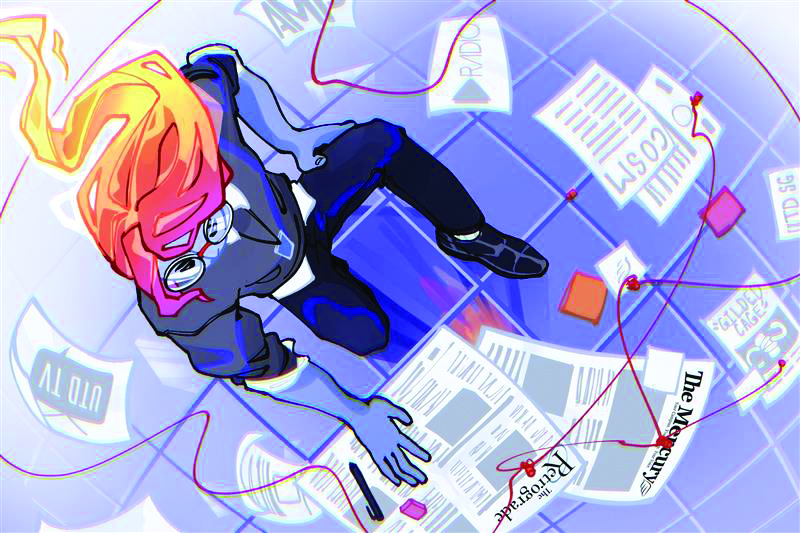
Working for The Mercury is supposed to be a rewarding experience where writers learn how to capture an audience, report ethically and take responsibility for their work. For many, journalism is transformative. It is an experience that holds institutions accountable and amplifies voices that are often ignored, especially when considering them is uncomfortable.
The Mercury has spent the last six months laying the foundation for writers, photographers and artists to produce consistent and responsible journalism for the UTD community. Training a growing staff with varying talents and skills has been both challenging and rewarding, and we have taken responsibility for learning from mistakes, including the embarrassing ones.
Student journalism at UTD isn’t confined to one newspaper. There is another student-run publication that reports on the same campus, events and students, though they are not affiliated with or funded by the university. Sharing an audience with another outlet requires a basic obligation to interact with one another responsibly.
While The Retrograde has publicly asserted claims about The Mercury’s staff, no member of that outlet has reached out to any Mercury staff member to request comment, verify, contextualize or discuss those claims. In a published editorial on Nov. 17, 2025, The Retrograde levied sweeping accusations without engaging in the most basic reporting practices.
It is deeply ironic for The Retrograde to invoke the Society of Professional Journalists’ Code of Ethics in the same editorial that labels Mercury staff as “puppets” and “fresh meat.” To “seek truth and report it” means little if it can be twisted into permission to delegitimize fellow student journalists rather than engage with their work.
A free press is not about silencing others’ voices to platform your own, and ethics are not a costume that can be put on and taken off when convenient.
Delegitimizing journalists becomes easy when labels are assigned to students while the quality of their work remains ignored. This is how journalists are brushed aside and interview requests are left unanswered. As a result, reporting suffers.
We aren’t resistant to pushback. With an entirely new staff, mistakes are inevitable, which is why feedback is crucial. As a publication that strives to represent students, it is essential that we listen to our readers. Anyone who disagrees with our coverage has the opportunity to submit an op-ed or letter to the editor. The most difficult and uncomfortable conversations Mercury staff have had with others have directly improved our journalism and the way we report.
This is not an issue of harsh criticism.
Within Student Media, criticism is too often conflated with degradation. Numerous Mercury staff have reported inappropriate behavior in shared spaces, often occurring outside of office hours. Criticism stops becoming instructive when it becomes personal, and the goal shifts from being constructive to undermining those producing the content.
This isn’t an issue specific to The Mercury. Over the past several months, reports of misconduct and behavior have affected every outlet within Student Media. Leaders from multiple Student Media outlets have met in attempts to make the office a safer and less intimidating place to work.
Since serving as editor in chief, I have had numerous staff members express fear of working in the shared office space, particularly at night. One staff member told me they didn’t feel comfortable seeking advice from a member of another outlet due to the current climate within Student Media. Whether we like it or not, The Mercury, UTD TV, Radio UTD and AMP all operate in a shared office, which means we share resources, equipment and ideas.
The need for Student Media leadership to convene regarding basic standards of collegial conduct raises a serious question about whether Student Media can fulfill its responsibility to serve students at UTD.
These issues go far deeper than what gets said and published, and they begin at a governance level. All outlets under UTD Student Media operate under Student Affairs through the Committee on Student Media, also known as COSM, which is composed of students, professors, advisors and staff. COSM oversees “general operations” of The Mercury, AMP, Radio UTD and UTD TV.
Governing bodies should be composed of impartial members to preserve legitimacy and build trust with the organizations they govern.
That responsibility requires impartial committee membership of consideration by its members. Oversight loses trust and credibility when those charged with governance have expressed public hostility towards those they are meant to oversee.
That standard was quickly dismissed when Student Government appointed two editors from The Retrograde to COSM in fall 2025 — the same editors who referred to Mercury staff as “puppets” and “fresh meat.” Concerns about conflicts of interest have been publicly raised during COSM meetings, yet appointments proceeded anyway.
This is not simply a governance failure. It is a betrayal of every journalist working in Student Media.
At what point did it become acceptable for members of a publication that has publicly denounced another newsroom’s legitimacy to simultaneously hold authority that includes selecting that same newsroom’s editor-in-chief and managing editor?
How does one justify allowing representatives of a competing outlet to participate in discussions that include sensitive operational questions, when those questions could be used to gain a competitive advantage over a publication that COSM is charged with protecting?
If Student Government wants to claim it supports student journalists, it must take immediate action to ensure COSM is not undermined by appointments that reward contempt and provide oversight power to those who publicly delegitimize the publication it is charged with overseeing.
With new COSM representatives set to be appointed in May for terms beginning June 1, Student Government must decide whether it will prioritize fairness and integrity or continue down a path that severs trust across Student Media.
Journalism cannot thrive when ethics are selectively applied, workplaces are unsafe and oversight rewards contempt toward the journalists it is supposed to protect.

Willow • Feb 10, 2026 at 1:49 pm
It is a ludicrous proposition that the UT Dallas Student Government shouldn’t appoint members of The Retrograde, that is, the official student newspaper (see S.R. 2024-05) to the Committee on Student Media.
I imagine that you disagree with the proposition that The Retrograde holds legitimacy here. And I’m sorry, but the Student Government was elected by the student body, and The Mercury’s staff wasn’t. You’re welcome to run for office or start a petition if you want to see things change!
milo • Feb 11, 2026 at 11:52 pm
How does it make sense for a competing newspaper to have decision-making power over another newspaper? COSM affects The Mercury, not The Retrograde. That’s a conflict of interest, regardless of who’s official.
T • Feb 12, 2026 at 11:35 pm
“I imagine” is a phrase that carries a *lot* of weight here.
Comprehension questions for literate, adult college students:
– Does the author say the Retrograde is an illegitimate publication?
– Does the author say the Retrograde’s editors shouldn’t be on COSM because it is not a university-affiliated publication?
– If a member of a governing body publicly degrades members of an organization that they’re meant to oversee and states the organization is illegitimate, could this constitute bias against that organization?
– What is the author’s stated concern about COSM?
Hope this helps! Literacy and effective text analysis is the backbone of journalism.