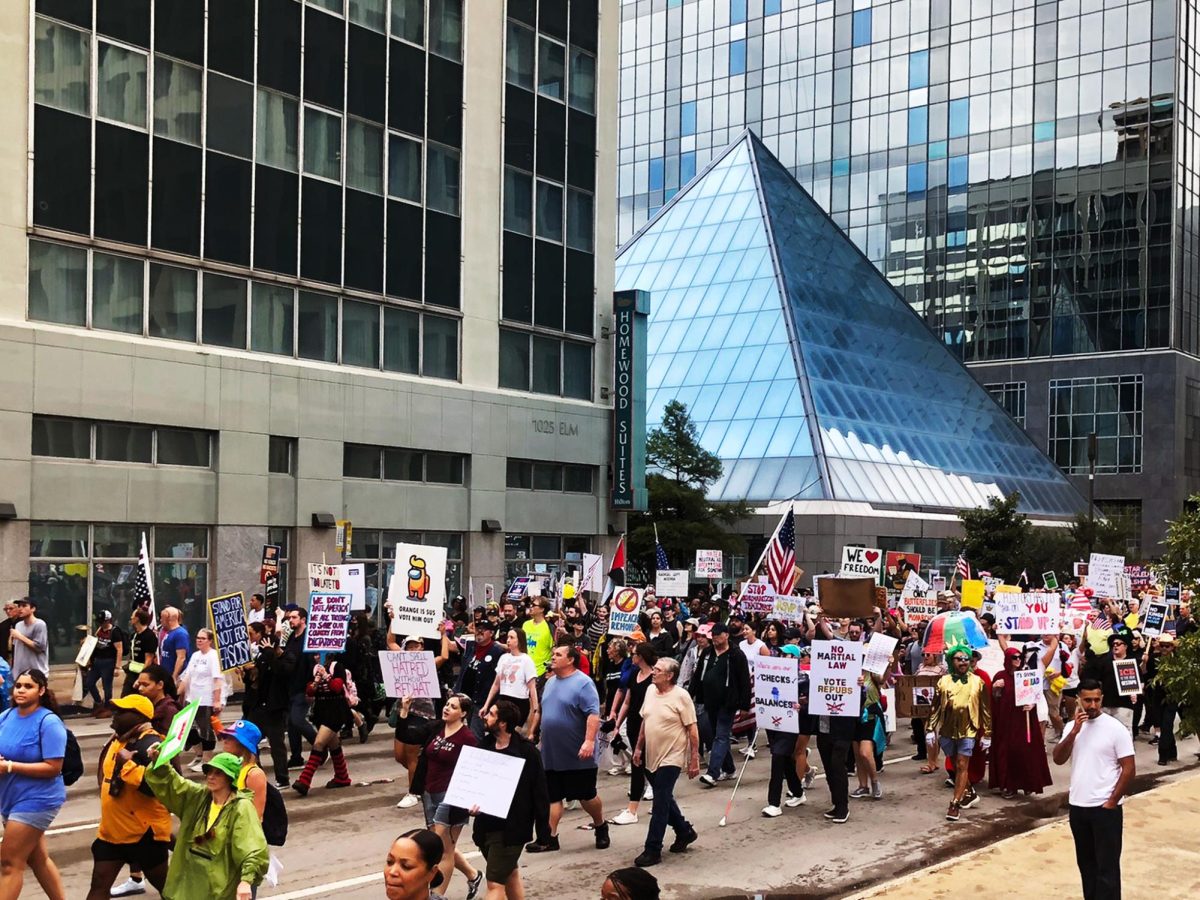
On Oct. 18, 2025, an estimated 7 million people took to the streets of more than 2,500 cities in one of the largest single-day protests in American history – larger than Dr. Martin Luther King Jr.’s famous March on Washington, the 2017 Women’s March, and, when excluding non-protesting participants, even the 1970 Earth Day protests. Americans of all ages, ethnicities, genders and walks of life marched in all 50 states and Washington, D.C., bearing signage, flags, and, in some cases, costumes to drive the message: “No Kings.”
In a demonstration 14 times the combined turnout of both of President Donald Trump’s inaugurations, organizers and participants of the October wave of No Kings protests voiced dissatisfaction with Trump’s second term in the White House, likening his actions in office to those of a dictator or, as the name implies, a king. A previous wave of No Kings protests took place in June earlier this year, but the recent turnout in October exceeded that of June by as many as 2 million people following the militarization of federal troops against American citizens and a continuing string of executive orders that seemingly challenged Americans’ constitutional rights.
These are not the only critiques people brought to the spotlight, however; signs poking out over the crowds contained messaging condemning the U.S.’s involvement with Israel’s actions in Gaza, highlighting President Trump’s ties to Jeffrey Epstein, and calling for the abolition of ICE. Although protests remained nonviolent across the nation, protestors made clear the White House continues to draw criticism from the public.
However, the No Kings protest in Dallas had one notable feature distinguishing it from similar protests across the country from Oct. 18: low turnout. Most estimates put the number of participants there at around 3,000 people, compared to 30,000 in Austin, and an estimated 200,000 in D.C.
This is surprising considering that the Dallas-Fort Worth-Arlington metro area is the fourth largest metro area in the United States. Even considering the other 7,900 protesters across those two cities, that only adds up to a little over one-third of the protest in Austin.
Organizers attributed low turnout partly to rain the day of the event, but said that other factors may have played a role.
“There’s no champion on the city council that resists it,” said John Fullinwider, a Dallas native, speaker at the Dallas protest and longtime activist. Without a leader, or someone in power representing the people who are protesting, it is much harder to get people organized, in part because, “If your hope is low, then your activism is low. When you have a rising expectation, then you get more … revolt, you know?”
Another potential reason, according to Fullinwider, is what he described as “loss of job fear.” The concern refers to individuals worried that their employment status could be affected by political statements, a fear that has gained relevance after the recent death of conservative firebrand Charlie Kirk. The New York Times reported that more than 145 people have been fired or disciplined because of comments made about Kirk after his death.
Residents in Washington, D.C., faced similar worries. Many participants avoided sharing their full names or personal details, acknowledging that taking a vocal political stance could carry risks. Still, large crowds gathered across the city.
“We were aware that maybe there’s consequences, but at the end of the day … we’ll laugh in the face of those consequences,” said Jack Humphrey, D.C. resident and software engineer. . Protestors were aware of repercussions but chose to participate regardless.
Mehdi Hasan, award-winning journalist and editor-in-chief of Zeteo News, reflected that determination when he told the crowd, “We are not spectators. We are citizens. We are proud and patriotic Americans, and we will not allow our country to be taken over by demagogues and dictators.”
Humphrey explained that being in D.C. gave many protesters a sense of confidence and responsibility.
“
“When you’re standing at the doorstep of the nation’s capital, you’re like, okay, this is real,” he said. “This isn’t just people in some random city – this is where decisions are made.”
That proximity to political power gave many participants a sense of duty to use their voices to amplify those who could not safely speak up for themselves. In D.C., several prominent lawmakers and public figures openly aligned with the protest’s message, reinforcing the idea of proudly exercising their First Amendment right to free speech – and giving residents the sense that they were being genuinely represented by their political leaders.
In Dallas, the atmosphere felt different. Ahead of the protests, Gov. Greg Abbott ordered the Texas National Guard to Austin, saying “Violence and destruction will never be tolerated in Texas.” As a result, state leadership’s response to the protests appeared to discourage political activism across the state.
The lack of visible support from state leadership went beyond the protests themselves. Many Texans, including students, said they felt a broader disconnect from those in power, not only in the right to protest but in feeling heard at all. “I really don’t feel represented by the state at all. People like Governor Abbott don’t have the public’s best interest at heart when making decisions. They act according to their pockets,” UT Dallas sophomore Alec Reifel said.
Some UT Dallas students say this feeling of disconnect extends to campus administration.
“Judging off the history I know, I would probably be a little more cautious talking about my views,” said economics freshman Moses Swigart, who attended the No Kings protest in Dallas. “All the faculty members I interact with on a weekly basis, I wouldn’t have any troubles. … That may be different once I get to the C-suite people.”
To those in Dallas, even though a lack of representation among authority can hurt morale and drive down turnout, the protests provided a means of representation for those without.
“[The No Kings speakers] hit a really wide base. … There were speakers there that resonated with me, but there were also speakers that resonated with every different type of person there,” Swigart said of the Dallas protest. “The central message was just, organize more, you know? Get on the ground, do your part, go to more protests. … Stay together, because that’s how you lose, if you break apart.”
“If you were to ask Greg Abbott if it was radical, he’d tell you it was,” Swigart continued. “They [the protestors] definitely are not represented by our government.”
With the recent string of Democratic victories over Trump-backed candidates from the midterm elections earlier this month – in particular those of New York City Mayor-elect Zohran Mamdani and the victors of the New Jersey and Virginia gubernatorial races, Mikie Sherrill and Abigail Spanberger, respectively – those in support of the No Kings protests maintain hope the protests are having the desired effect in breaking the president’s sway in government.
“I’m very optimistic, even delusionally so, that history will fix itself in time,” Swigart said. “I have faith in humans and goodwill that we will get to a better spot, and I think we are.”