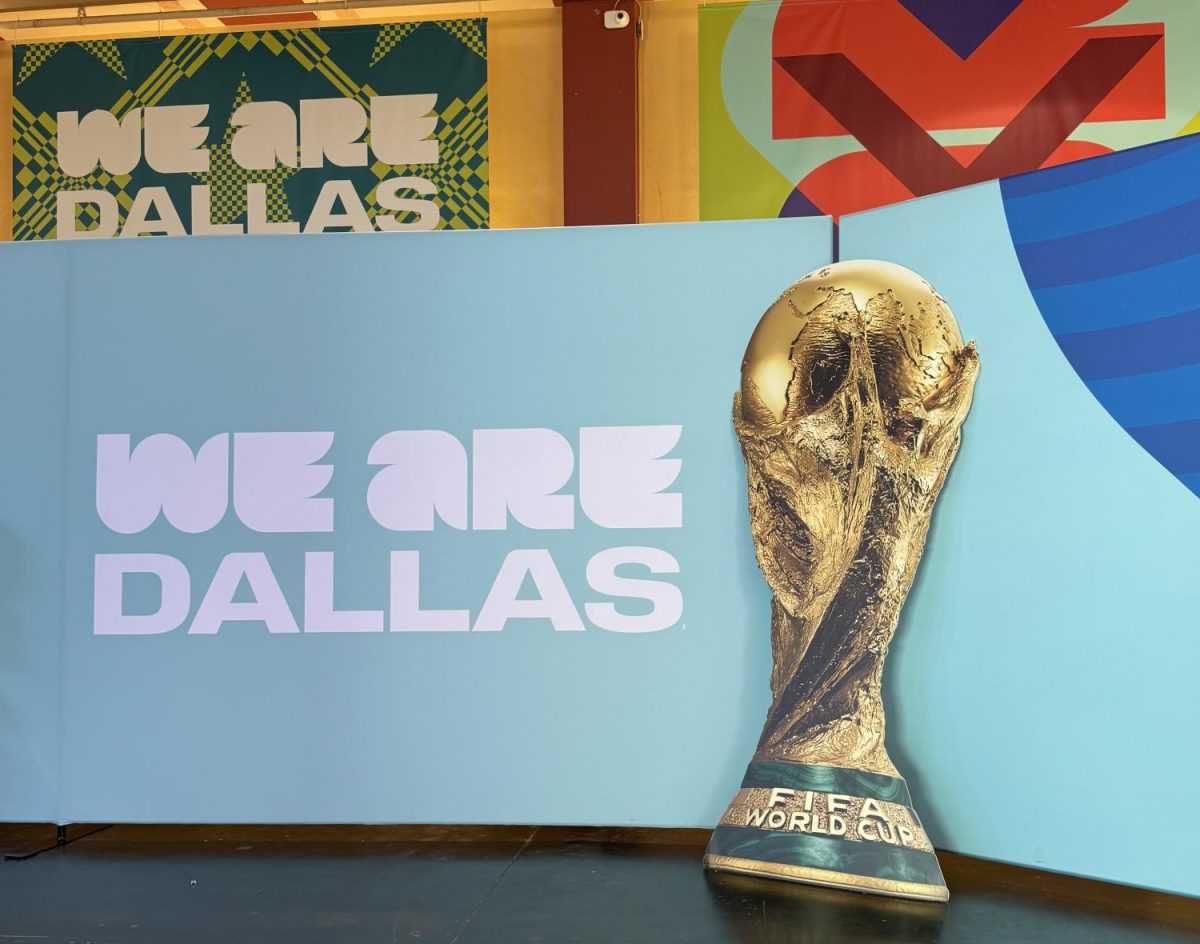
This summer, part of the world’s most watched sporting event will take place in UTD’s backyard.
According to Inside FIFA, 2.21 billion people watched at least 20 minutes of the 2022 FIFA Qatar World Cup on live TV alone. This year’s tournament takes place across the United States, Canada and Mexico, with Arlington’s AT&T Stadium hosting nine matches, including a semifinal game.
Considering soccer’s lessened popularity in America compared to the rest of the world, a brief refresher on the game’s rules and structure, as well as the tournament’s setup, may be necessary.
At its core, a soccer team consists of four positions: attacker, defender, midfielder and goalkeeper. Each team has 11 players, with one goalkeeper and any mixture of the other positions.
Attackers: Attackers are primarily focused on getting the ball in the other team’s net to score a goal. Many of the game’s most famous players are attackers, including Lionel Messi and Cristiano Ronaldo.
Defenders: Defenders try to prevent the other team’s attackers from doing their jobs, mostly by hanging near their own goal to frustrate any attempt to get the ball within range.
Midfielders: Midfielders do a little of both offense and defense, often acting like generals on the field to lead and facilitate attacks, as well as maintaining the defensive structure.
Goalkeepers: Goalkeepers have a more unique role. They are the last line of defense against any opposing attempt to score and are the only players allowed to touch the ball with their hands, as long as they stay inside their own penalty box. Goalkeepers wear a different color jersey to ensure referees can tell them apart.
If any other player uses their hands, they commit a foul. There are a variety of fouls, with individual infractions usually resulting in one of two outcomes: a yellow card or red card.
Yellow cards: Yellow cards are given as a formal caution for reckless or unsportsmanlike behavior. If a player receives two yellow cards, they are shown a red card, causing the player’s disqualification. Once a player is ejected, they cannot be replaced, resulting in lopsided teams for the rest of the match.
Red cards: Red cards can be given directly for serious offenses such as violence or verbal harassment. They are also given if a non-goalkeeper intentionally uses their hands to prevent a goal.
Minor fouls: Minor fouls often do not rise to the level of a yellow card, in which case possession is given to the opposing team with no cards shown.
Each soccer game consists of two 45-minute halves separated by a 15-minute halftime. Unlike many other sports, the game clock runs continuously, even when gameplay stops. In the case of an interruption, like an injury, the clock runs and the referee adds the lost time to the end of the half.
If the game is tied after 90 minutes, one of two outcomes occurs. In the early stages of the tournament, the game ends in a draw. In the knockout stage, the game transitions to overtime, consisting of two 15-minute halves with the same timing rules as before. If the game is still tied after overtime, there is a penalty shootout, in which teams take turns shooting at their opponent’s goal with only the goalkeeper defending.
The World Cup itself has its own rules for how teams compete and progress. Initially, the 48 teams are split into 12 groups of four. Within each group, the teams play each other round-robin style, earning points for their results.
Win: Three points.
Draw: One point.
Loss: Zero points.
Once all members play each other, the two with the most points automatically advance to the Round of 32. Of the 12 third-place teams across all groups, the eight highest-scoring teams also advance. From here, the teams compete in a single-elimination bracket tournament, similar to March Madness. The last two teams will meet at New Jersey’s MetLife Stadium for the World Cup Final.
The 2026 World Cup officially starts June 11, with Mexico facing South Africa in Mexico City. The U.S. opens against Paraguay in Los Angeles on June 12.