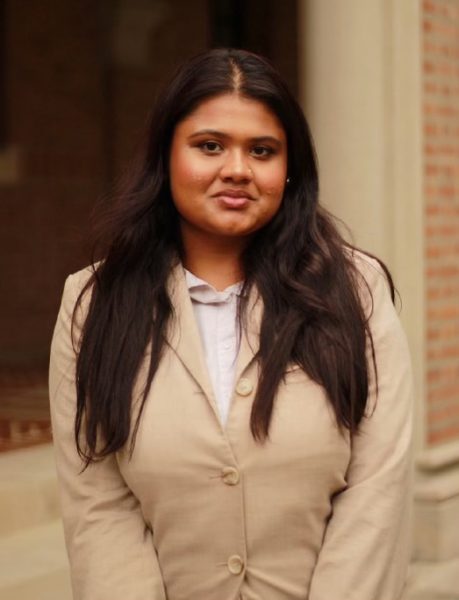
David Baker and Farhan Iqbal were elected Student Government president and vice president, respectively, on May 1, ushering in a new era of leadership focused on increasing student engagement, bringing internal reform to SG and lobbying student interests to administration.
In an interview with The Mercury following the election, Baker and Iqbal discussed their plans for the summer and fall during their upcoming term.
Baker and Iqbal said they plan to protect student rights and expand resources for mental health and health initiatives, including emergency contraception and menstrual products in bathrooms.
Baker said one of his top priorities is connecting with students as much as possible.
“We are coming back from a very low-engagement election from this past spring and something we really want to work on next year is trying to get a lot more engagement with the students,” Baker said.
Baker said they plan to create a committee for peer advisers to get them involved in student engagement. He said SG also hopes to involve more ECS and graduate students after some seats went unfilled in the election.
Baker said SG also plans to expand its monthly tabling to better communicate available resources to students.
“We sit [in the office] for 20 hours a week, but a lot of times we don’t have people coming by because they don’t know we’re an option as a resource to advocate, so trying to move these spaces to student-friendly areas — like the Plinth — can be very good,” Baker said.
Iqbal said Student Government plans to reach out to student groups proactively.
“There’s a difference between saying ‘we’re here’ and us going to big student organizations and meetings, or different council meetings and classrooms, and proactively going to these students and reaching out,” Iqbal said.
The New Wave ticket recognized concerns such as food and housing insecurity as prominent issues for UTD students.
Baker said SG can help connect students to existing campus resources.
“I think the offices on campus have a lot of good resources that students aren’t really aware of, and I think letting students know ‘hey here’s some resources,’ can create support,” Baker said.
Baker and Iqbal said they are revising internal documents, including a transition guide from 2020 that lists responsibilities SG no longer follows. They are also requiring committees to meet over the summer so the time between semesters is better utilized.
One new initiative students should expect in the fall is the Peer Advisor Advisory Committee, where SG will organize PAs, collect information and send recommendations to housing on behalf of peer advisers.
Baker and Iqbal also plan to continue building the Student Leadership Committee, a group of organizations across campus where student leaders can discuss projects and goals.
“A lot of times these organizations have very similar goals but they work to these goals in a vacuum, so trying to build bridges with these organizations allows us to change and support each other’s events and advertise our projects to student populations,” Baker said.
Baker said a common misconception about SG is that it has more direct power over university policy than it actually does. Although SG cannot change policy directly, Baker said it can lobby administration and push for alternatives.
“The drag ban that happened last semester, or Artist Alley, those were policies that student government can’t change, but we have the ability to lobby with the administration, to create workarounds or pathways or even overturn the rules themselves,” Baker said.
Some members of the student body have protested the suspension of Students for Justice in Palestine, which many students view as a wrongfully targeted action by administration.
Iqbal said SG aims to support students and their concerns and is conducting an ongoing investigation into the suspension.
“If there appears to be wrongful suspension — which it appears so far –- we are going to investigate it, present the facts to administration and work with the students and everybody and present why we believe [the suspension] may have been incorrect,” Iqbal said.
Baker and Iqbal said they want their upcoming term to bring internal reform to SG. Baker said past leadership has not always provided transition documents, leaving new leaders without a clear understanding of ongoing responsibilities.
“I would hope that our year is seen as a very transitional time to essentially a new elevated Student Government, taken very seriously with the administration. Coming from trying to rebuild a culture of support, a culture of advocacy and a culture of collaboration,” Baker said.