

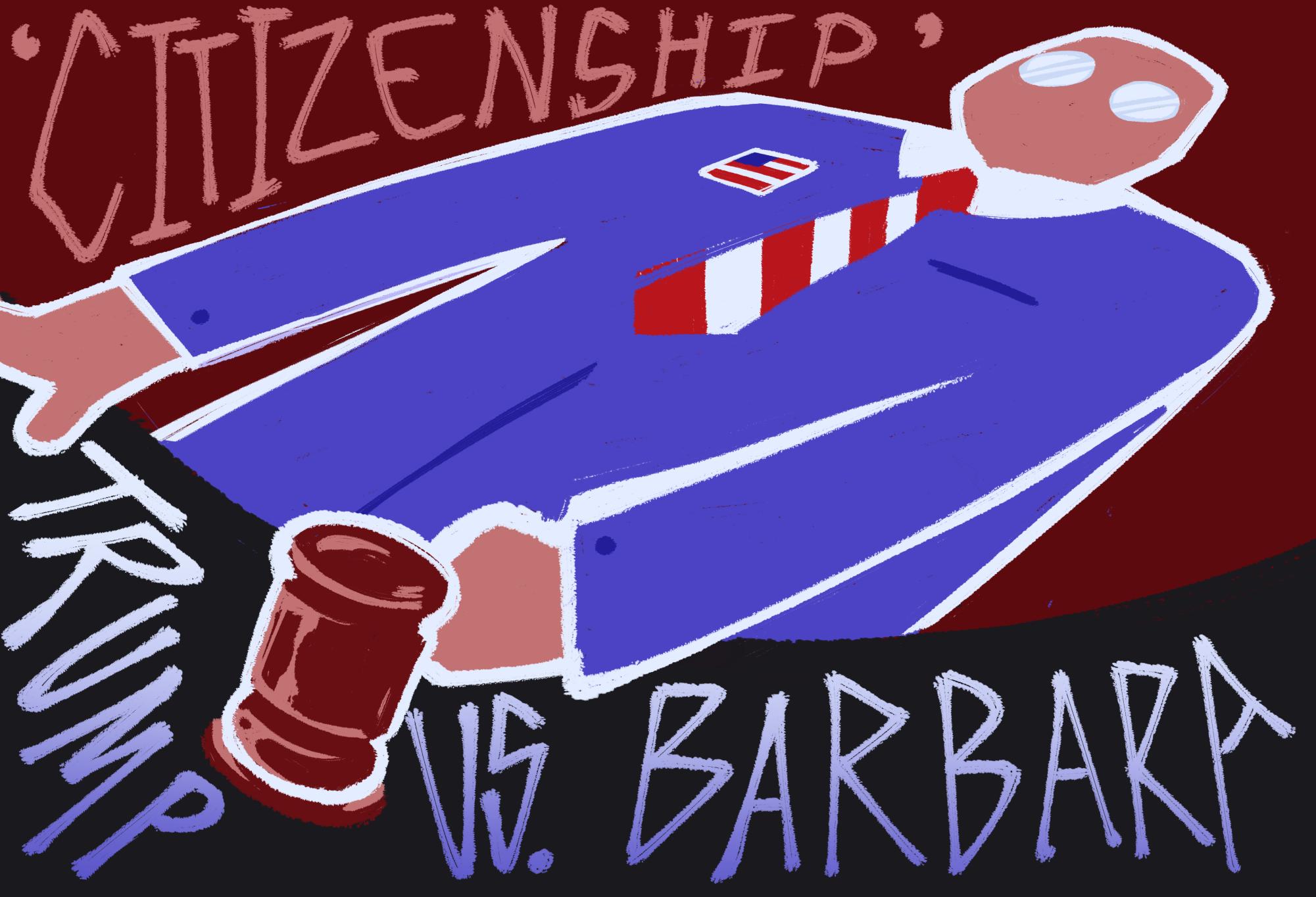
The Supreme Court’s birthright citizenship case hits home at UTD, where many students are children of immigrants or immigrants themselves.
Students like Sayali Rao, a political science junior and president of the South Asian American Voter Empowerment club, say national decisions like this significantly impact her and her community.
“Even though I was born here, it definitely made me realize that as a child of immigrants, I am affected by decisions I have no control over,” said Rao.
Background of the Case
For over a century, the U.S. has interpreted the 14th Amendment, which states that “all persons born or naturalized in the United States, and subject to the jurisdiction thereof,” to mean that nearly everyone born on U.S. soil is automatically a citizen — regardless of the citizenship status of one’s parents.
This became contested when the Trump administration signed an executive order on Jan. 20, 2025, that directly ordered federal agencies to deny U.S. citizenship to any child born on U.S. soil if their parents had been unlawfully present or under temporary visas, as reported by the American Bar Association.
Immediately after the order was signed, multiple district courts had issued nationwide injunctions — a court order for a party to refrain from an act — in attempts to block the order.
However, in a preliminary ruling in Trump v. CASA, Inc., the Supreme Court held that district courts generally cannot issue nationwide blocks. This forced the challengers to file new class action lawsuits against the executive order.
Rather than waiting for the First Circuit Court of Appeals to rule, the Trump administration petitioned the Supreme Court to take up the case directly.
The Controversy Around the Case
Some constitutional scholars and legal experts say the court’s decision to hear the case is incredibly peculiar.
Douglas Dow, a constitutional law professor at UTD, said there didn’t need to be a Supreme Court case in the first place, as three different lower courts and three different appellate courts found this order to be in direct violation of the Constitution.
“That is part of the controversy — why has the Supreme Court decided to take this case to oral arguments, when there is no disagreement anywhere in the lower courts about the proper answer?” Dow said.
The Supreme Court of the U.S. receives between 7,000 and 10,000 petitions to review each year and only accepts to hear the oral arguments for roughly 1% of the total. To pick up a case amongst the tens of thousands in which the lower courts don’t disagree on is unusual.
Anthony Champagne, constitutional law professor and director of the Pre-Law Undergraduate Program at UTD, said that the court picking up the case may not be as peculiar as the court tends to defer to cases from the President.
“But the court tends to defer to any presidential administration, the court is somewhat open to hear an appeal, so there is this somewhat tradition to hear appeals from lower courts,” said Champagne.
Potential Outcomes
The constitutional law professors also highlighted potential outcomes in the case where birthright citizenship is no longer determined to be a constitutional right, or otherwise.
Dow said redefining birthright citizenship would signal that even long-standing interpretations of the Constitution are no longer secure.
“It is going to be done against the plain words of the Constitution, against the intent of those who ratified the 14th Amendment,” Dow said.
Scholars have expressed the real possibility that such laws could create a class of individuals who may have no state in the first place.
“The nation from which their mother or both their parents are from may or may not claim them as a citizen of their country, but the United States is not claiming them. That’s how you have statelessness, when there are human beings that no sovereign state will claim as a citizen or legal resident of that place,” Dow said.
Dow additionally raised concerns about how such a decision would affect public perception of the Supreme Court, raising questions about whether people’s confidence in the Supreme Court can go any lower than it already has.
UTD First-Generation Students React to the Case
First-generation students at UTD see this issue incredibly differently.
Shriya Chapagai, a criminology sophomore, expressed concerns over how the citizenship of several members of her family could be contested if the Supreme Court holds that birthright citizenship needs to be reinterpreted.
“This affects me and my family pretty huge,. The only people that were really born on American soil are the youngest in my family, so the idea that several members of my family can just be considered non-citizens in just one decision is definitely a scary thing to consider,” Chapagai said.
Chapagai said she struggles to wrap her head around the rise in anti-immigrant rhetoric, considering how the country was founded on the establishment of immigrants in the first place.
Additionally, Chapagai is concerned about how such cases shape the perception of immigrants in American society.
“When I was growing up, it seemed clear that everyone was welcome here and despite being people who were fleeing persecution we still had a right to be here and right to live a better life, but I think that in the past couple of years, especially during the Trump administration, they have spent a lot of time kind of breaking down those ideas and turning them from ones we should value to ones we should fear,” Chapagai said.
Rao said immigrants have become an even greater focal point in politics in recent years.
“It shows that immigrants are always the center of politics. Politicians, more importantly, President Trump, want to control the rights of immigrants more than anything else,” Rao said.