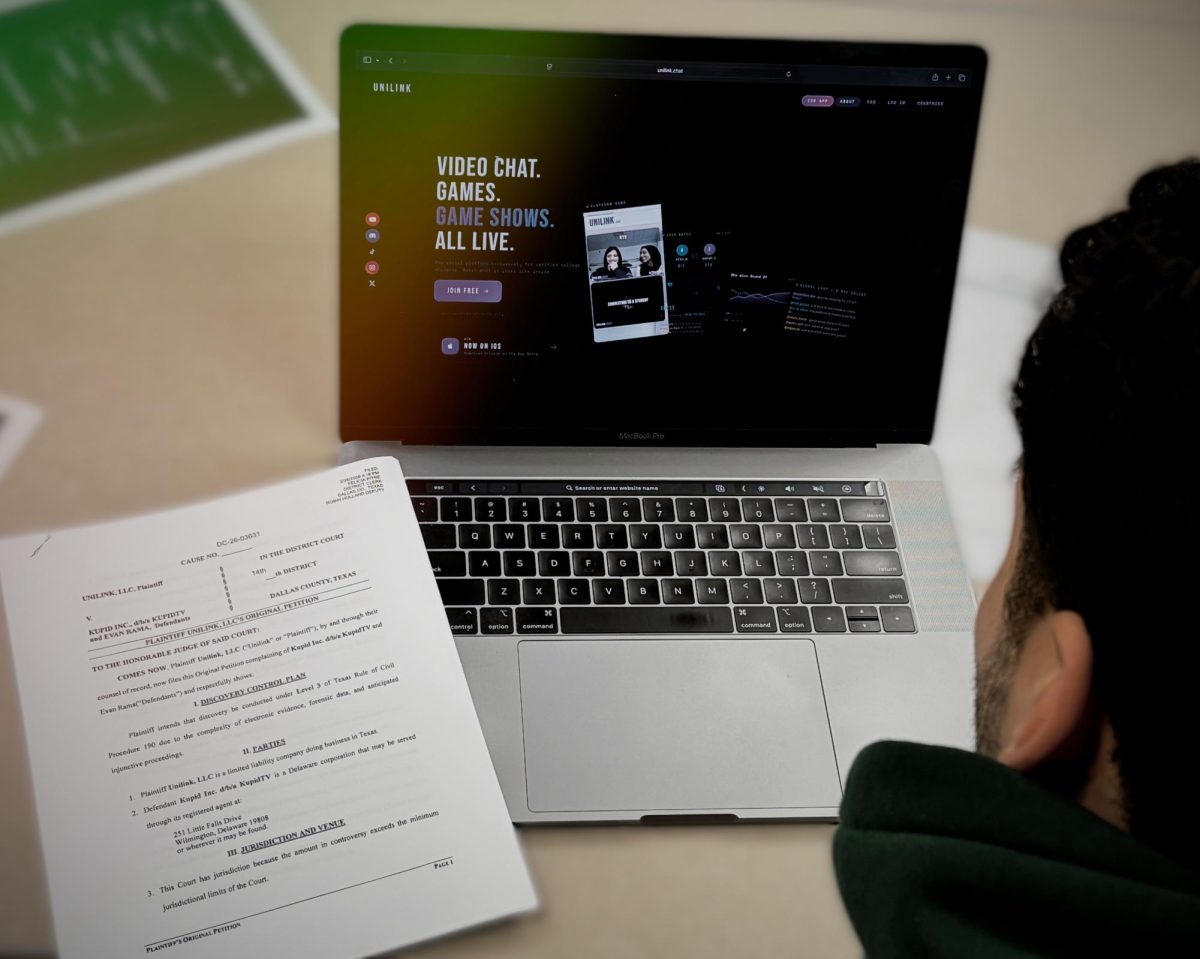
A UTD student says he rejected a six-figure buyout offer, only to watch his startup get flooded with thousands of fake followers and spam comments.
Now, he is suing the company he blames.
The case
Hamza Hammad, a UTD computer science junior and founder of Unilink, LLC, filed the lawsuit Feb. 26 against Kupid Inc., which operates KupidTV, and its CEO, Evan Rama (Cause No. DC-26-03631).
The lawsuit alleges business interference, reputational harm and violations of Texas laws related to electronic interference and bot activity.
Legal experts say cases involving alleged bot attacks can be difficult to prove.
“It’s quite hard to show who’s responsible for a coordinated bot attack,” said Eric Goldman, associate dean of research at Santa Clara University School of Law.
Goldman said much of the relevant data may not be accessible to the victim.
“The data may reside in third-party hands … and an attacker would almost certainly cover their tracks,” he said.
The case remains open with no rulings or judgments on record.
The Mercury reached out to Kupid Inc., Rama and employees for comment. As of publication, The Mercury has not received a response. Rama has since deactivated his Instagram account. If Rama or Kupid Inc. responds, The Mercury will update this article.
The companies involved
Unilink is a video-based chat platform built for college students. According to its website, it was created to give students “a safe place to talk, meet new people and have fun — without the risks found on public video chat platforms.”
KupidTV is also a college-focused video platform. Rama described it as “a live blind dating show that operates as a 24/7 game show platform for college campuses.”
On April 27, KupidTV officially rebranded to CRSHMARKET, according to a LinkedIn post by Rama. In the post, Rama said the company is expanding beyond its original concept into what he described as a “livestreamed prediction market.”
The company has not publicly addressed if the rebrand is related to the lawsuit.
The rejected offer
Hammad said the conflict began when KupidTV approached him with an acquisition offer.
“Every time I said no, they increased the offer,” he said. “It reached past six figures, and I still rejected it.”
He said he ultimately declined because the platforms served different purposes with foundational differences.
According to the legal documents, the rejection was followed by Kupid’s acquisition of DormParty, a platform the filing describes as a direct Unilink competitor. The lawsuit alleges the subsequent bot attacks were a deliberate attempt by KupidTV to eliminate its competition.
The alleged attacks
According to the lawsuit, Unilink began experiencing what the petition describes as “coordinated automated bot attacks” within weeks of the rejected offer. Hammad said he first noticed the activity on Dec. 12, 2025.
“My phone just kept buzzing and buzzing and buzzing,” he said. “I opened it, and all of a sudden, I got 4,000 followers in one second, and I would get multiple spam — like hundreds and hundreds of spam comments of curse words or flipping emojis to flag my account to get banned.”
As a result, Hammad said Instagram disabled Unilink’s account for violating its account integrity policies, documented as Exhibit A. Instagram restored the account about a week later, but Hammad said the activity continued through late December and into February 2026.
Court documents filed by Hammad include an analytics graph that highlighted irregular follower spikes across that period.
He said the alleged activity also targeted accounts with no public connection to Unilink.
“The second I uploaded on my Instagram, they would send another thousand bots. It was as if someone was watching over and seeing if there was another account associated with us to have a backup, and they would go after that,” he said.
The disruptions forced Unilink to pause its social media operations for nearly two months.
“From December until February, I really couldn’t navigate around that. We had to put a full pause on our social media,” Hammad said.
Experts say attributing this kind of activity to a specific party is often one of the biggest challenges in cases like this, especially without access to internal platform data or verified forensic analysis.
The alleged admission
One set of potential evidence filed by Hammad is screenshots from a disappearing-message conversation with an unnamed Kupid employee.
In the screenshots included in the filing, the alleged employee appears to describe multiple forms of interference, including bot activity and a distributed denial-of-service attack, commonly known as a DDoS attack, which typically refers to an attempt to overwhelm a website or online service with unmanageable traffic.
The messages include statements such as: “They did bot,” “It was also DDoS,” “They were checking your account every day, scheming to bot you and mess you up,” and “They wanted to play dirty.”
On advice of his attorney, Hammad declined to identify the alleged Kupid employee.
Goldman said evidence like this may be difficult to rely on without direct testimony, and cautioned that allegations in a filing carry limited weight on their own.
“You can say whatever you want in a complaint, but if you can’t back it up, the court can’t credit it,” he said.
The impact
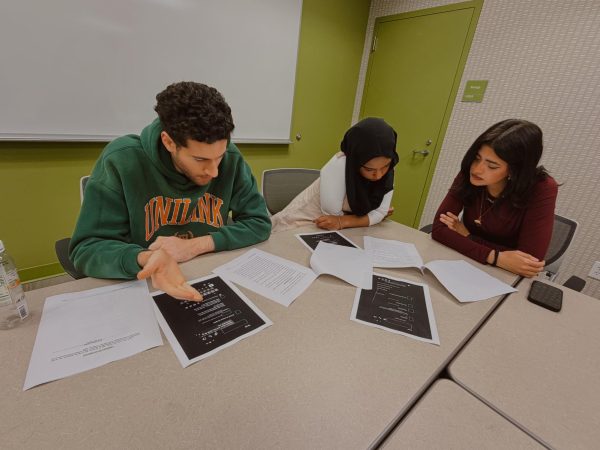
Hammad said the alleged activity damaged Unilink’s relationships with investors and advertisers.
“It makes us look like we’re frauds,” he said.
Shahad Ibrahim, a health care management sophomore and Unilink team member, said the alleged attacks limited what members could accomplish.
“It pushed us back because we couldn’t post anything. We had so many ideas, but we couldn’t work on any of them because of the botting. So it was just stagnant for a couple weeks,” Ibrahim said.
Despite that, Hammad said he hopes the case resonates with other student entrepreneurs.
“When you see a bigger guy and you feel threatened, still go for it,” he said.
To the courthouse
Before filing, Hammad said his legal team gave Kupid 10 days to respond to a settlement demand. When the deadline passed on Feb. 25, he said the company denied any involvement. The lawsuit was then filed on Feb. 26.
Unilink is seeking compensation for lost profits and reputational damage, along with additional damages. The filing also invokes a Texas law that allows courts to triple the damages awarded if a pattern of bot activity is found. Unilink has requested a jury trial, although Hammad said he would prefer to resolve the case outside of court.
“I don’t want to cause more trouble and would prefer to handle this in negotiations instead of going to court,” he said. “I want to go back to just focusing on Unilink.”
The Mercury will continue to follow this case and provide updates as the story develops.