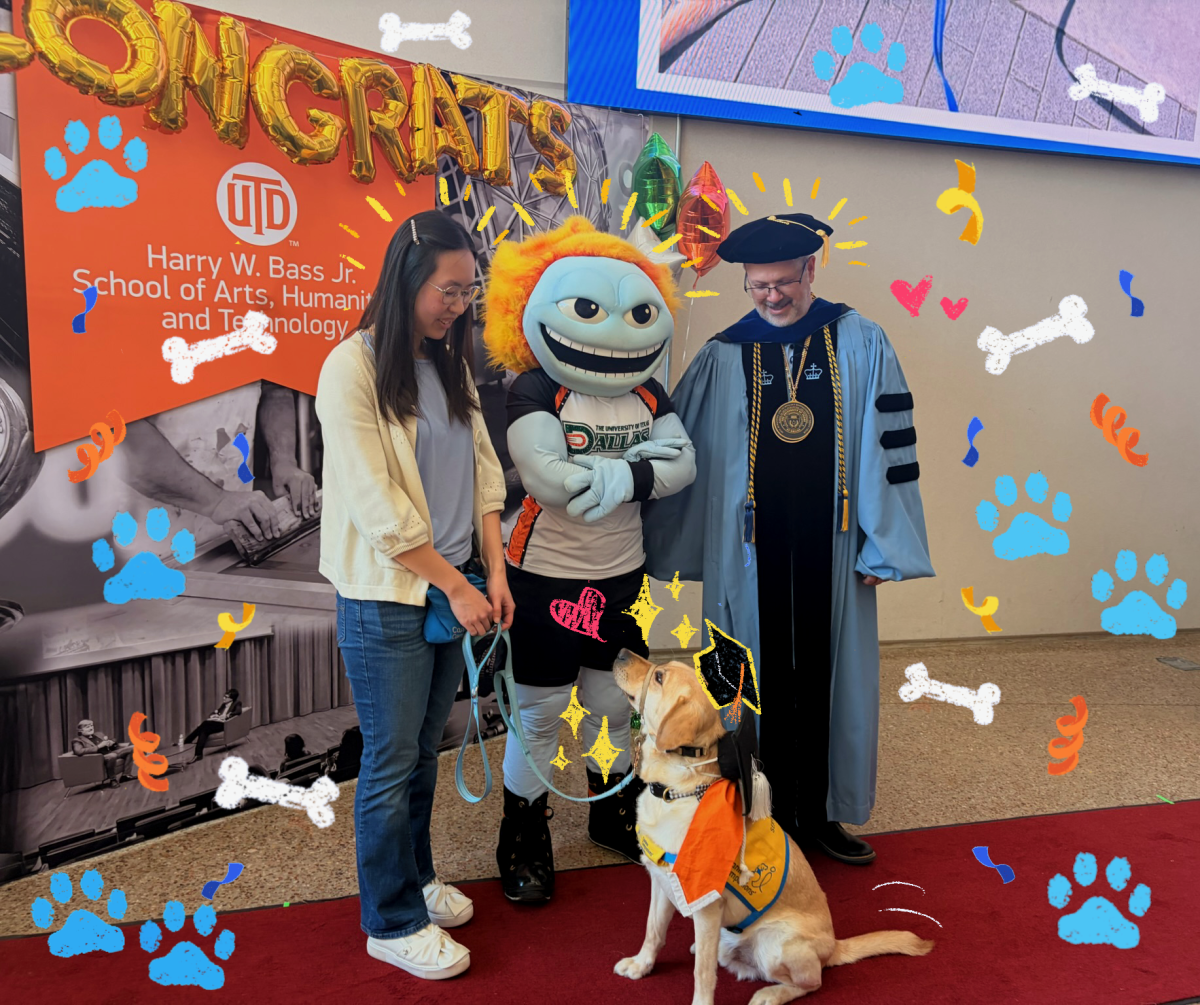
On Feb. 6, 2026, Nero, a 17-month-old Labrador/Golden Retriever cross walked across the stage at the Edith O’Donnell Arts and Technology Building to accept his puppy diploma.
The ceremony marked the end of his time with the University of Texas at Dallas Service Dogs in Training program–- a student organization that raises and socializes potential service dogs on campus— and the beginning of professional training through Canine Companions, a national nonprofit that provides service dogs to people in need at no cost .
UTD SIT has dozens of active members and puppy sitters who help raise and socialize dogs on campus. Members rotate puppy-sitting shifts, help with fundraising, and bring the dogs to classes, events or even busy stores. The goal is to help the dogs learn to stay calm, no matter how loud or distracting things get. But every dog starts somewhere.
When Nero first arrived on campus in Oct. 2024, he was just 8 weeks old.
“He didn’t know anything,” said Carole Leung, a fourth-year doctoral student in cognition and neuroscience and Nero’s puppy raiser. “Now he’s 17 months old, and he has learned a lot. … He’s almost ready to be a service dog.”
Leung was involved with the program, SIT, before deciding to take on a bigger role. She applied through Canine Companions to become a puppy raiser. The process included training courses and several months on a waitlist. In October 2024, she was matched with Nero.
Over the past year, Nero and Leung have shared early-morning walks, squeezed training sessions between classes, practiced ignoring distractions in busy campus spaces, and still managed to have enough time to create a life-changing bond.
Before Nero crossed the stage, attendees were reminded of what comes next. A past graduate, Jones IV, returned to campus with his handler, Natalie Crawford, to speak about life after the program and what a fully trained service dog can mean for someone.
Crawford became disabled during college, and over time the experience took a mental toll, making her feel detached from her surroundings.
“It was like I was living life looking through a screen,” she said.
When neurological symptoms began to flare up, simple tasks became unpredictable. She said she often had to leave events early because she wouldn’t be able to drive after a certain point.
After being matched with Jones, she began teaching him additional cues tailored to her.
“I’ve taught him to put pressure on my shoulders,” Crawford said, explaining that the weight helps with grounding and neurological flare-ups.
“Now I can stay for the event and drive home,” she explained.
Within the first two weeks, Crawford felt a shift.
“He did for me what two years of therapy work did,” she said.
Jones’ impact goes beyond assisting with mobility tasks. To Crawford the most important part of having him isn’t just what he does — it’s that he’s there.
“It was like I woke up. I’ve started to be able to be me again,” Crawford said.
She described him as a “silly boy,” full of personality. That energy, she said, is part of what she needed.
“That’s been part of my healing,” she described.
Service dogs can cost around $50,000, a number Crawford said would have been out of reach. But through Canine Companions, she paid nothing. Still, she said her gratitude goes beyond the financial relief.
“These dogs don’t happen without the puppy raisers,” Crawford said.”I am so, so grateful.”
For Leung, seeing the real impact of UTD SIT makes the send off a lot easier.
“I don’t know what Nero will be [after the graduation], but to know that I’m helping someone I don’t even know is very satisfying,” she said.
For Emma Unger and Lily Evertse, co-presidents of UTD SIT, moments like graduation are a reminder of why the organization exists.
“Seeing a real example of what our dog can become really helps people,” Unger said. “No matter how small of a role you played in that dog’s path, it’s very impactful to see.”
Over time, that kind of shared responsibility creates a stronger bond than most student groups. Members rely on each other for puppy-sitting shifts, advice and support—especially when it’s time to say goodbye. Volunteer work often turns into something closer to a found family.
“It takes a village,” Unger said.
As Nero begins professional training, his future remains unknown. In a few months, he may be paired with someone who depends on him to open doors, retrieve medication or provide stability in overwhelming situations.
For UTD SIT, graduation is not the end. It’s a reminder that the small, sometimes unnoticed work of puppy raising adds up to something bigger.
And just as Nero leaves campus, the next chapter is already beginning.
UTD SIT will soon welcome a new eight-week-old puppy, Hagrid, who will begin training at UT Dallas this semester.
Learn more about UTD SIT and its work at utdsit.org