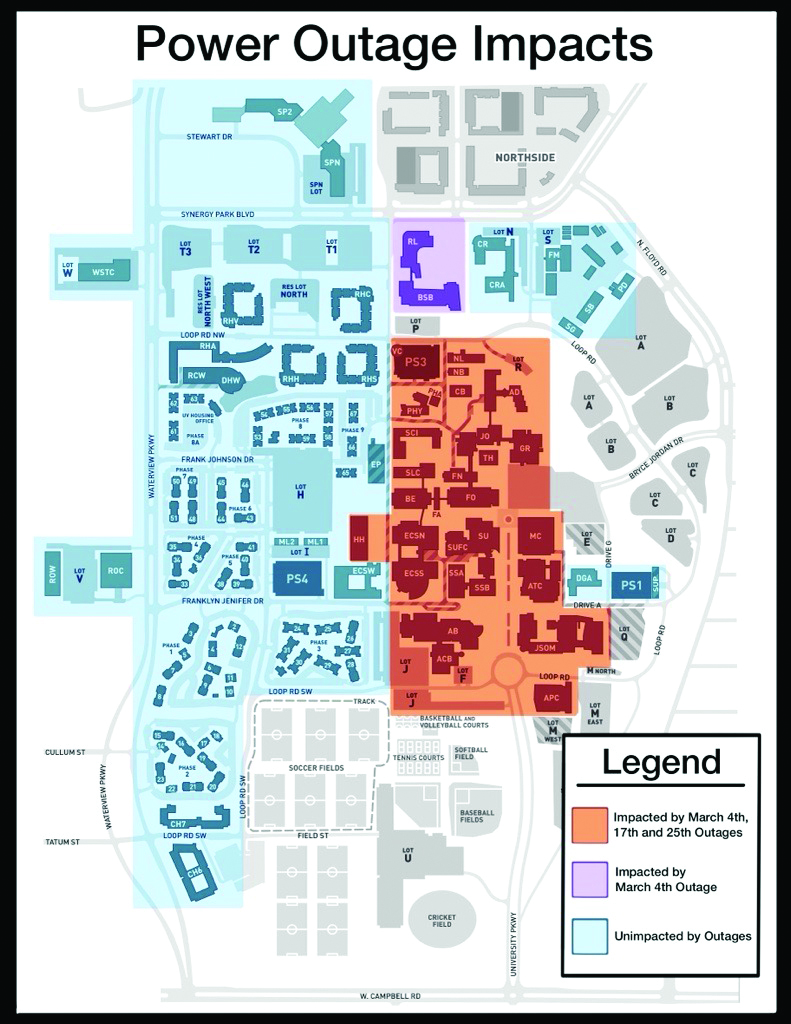
After a series of disruptions to power last month, UTD hosted a town hall on March 30 to provide information regarding the three power outages.
UTD has four main power feeders, each serving a different part of campus:
- M1 feeder
- Runs underground west of the Natural Science and Engineering Research Lab down to the central energy plant. Along with the M2 feeder, it serves the academic core
- M2 feeder
- Shares the same underground conduit as M1 from the north side of campus to the Central Energy Plant
- Also feeds the academic core
- M3 feeder
- Comes from the east side through the Satellite Utility Plant
- Covers Parking Structure 1, Davidson-Gundy Alumni Center and facilities compound in the northeast quadrant of campus
- M4 feeder
- Mainly serves residence halls, Parking Structure 4, Engineering and Computer Science West and Canyon Creek buildings
Because each feeder serves a different area, a problem on one feeder only impacts those buildings.
The first outage
The first outage was detected on March 4 at around 8:50 a.m. and impacted the academic core.
They determined that the outage was a result of a failure of the B-phase cable conductor in the M1 feeder.
As a short-term fix, they moved the loads normally on M1 over to M2, so that M2 alone powered most of the campus, allowing them to restore power around 12:30 the same day.
However, this meant the M2 feeder was carrying the full load while both feeders still shared the same conduit, leaving the system less resilient to change.
Martín said the long term solution to the March 4 outage is to replace all three phases of the M1 feeder, which consists of the A, B and C phases.
In a follow-up email to The Mercury, Martín said the university has secured a contractor who requested 8- to 12-hour shutdowns to complete the work and allow time to address any unexpected developments.
In the email, Martín said the contractor has begun preparations for the M1 repair project, which will span the rest of April through the end of May.
Martín said the university will “provide campus with as much advanced warning as possible.” He said they plan to do this on weekends so that they are “minimally disruptive to campus.”
They said they were in the process of contracting and planning, with the ideal solution being to replace the M1 and M2 feeders completely.
The second outage
The second, and longest, outage took place on Tuesday, March 17, and extended throughout March 21.
This outage impacted many of the same academic core buildings as the March 4 outage, except NSERL and Bioengineering and Sciences Building.
Martín said the outage was caused by an Atmos contractor drilling through multiple campus power cables. Martín said this work was not part of campus construction, but an independent infrastructure refresh by Atmos.
“We have already had communications with and a meeting with Atmos about this incident, and we will be … putting in additional safeguards to ensure that when a contractor is doing this type of boring on campus, that they’re locating all of our utility banks appropriately, and if an incident does occur, that we are immediately informed so we can start addressing the problem as quickly as possible,” Martín said.
Facilities Management completed repairs to the damaged cables March 20 through March 21. Power was restored the evening of March 21, though UTD didn’t resume normal operations until March 23 because the systems needed to be brought back online.
Martín said they will be “submitting claims for damages, all the work needed to repair, to Atmos and their contractor and their insurance providers.” In an email to The Mercury, Martín said the university is still collecting information on the damages incurred due to the March 17 outage.
The final outage
The third outage occurred March 25 around 9:45 a.m. and impacted the academic core. The problem was traced to the overloading of the M2 feeder. At that point, M2 was carrying the full academic core load because M1 was still out of service.
The short term solution was to reduce the load on the system by closing the Student Services Building, Student Services Addition and the Activity Center. This allowed classroom buildings to remain operational while reducing the strain on M2.
Power was restored around 11:02, with the exception of the SSB, SSA and AC.
On March 26, they shed a load from the NSERL and BSB to rebalance the system.
Martín said this requires the same solution as the outage on March 4, which means replacing the M1 and M2 feeders.
Looking forward
Kelly Kinnard, assistant vice president for facilities services and operations, said that UTD is “stable at this time” and that they are checking the electrical load four times a day and running it manually.
These outages also highlighted how UTD’s current infrastructure is under significant strain, as the main underground feeders serving the campus were installed 2007-08 with the expectation they would last 25 to 30 years. The lifespans have been shortened due to campus expansion and modifications that have pushed the system’s limit.
Combined with a small facilities staff and competitive market for skilled trades, UTD is being driven to conduct a N+1 study to determine what backup systems and new equipment the campus needs to keep the power reliable as it expands.