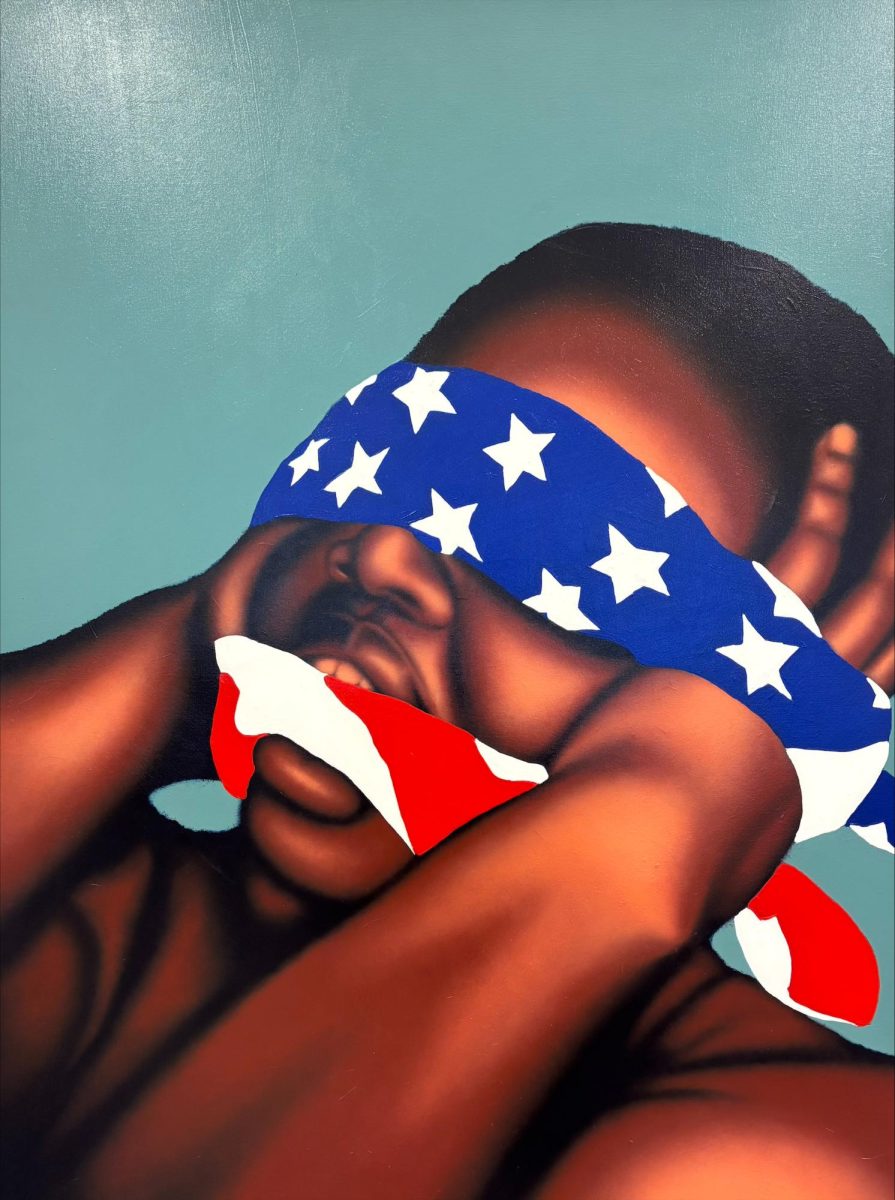
“I occupy a very interesting space,” said Dárē Akinwole, a visual and performing arts PhD candidate and teaching associate. “I’m aware that I’m not Black American, but I’ve lived here for so long that I’m not particularly Nigerian anymore, either.”
Born in Nigeria and now at UT Dallas, Akinwole says outlook is shaped by his time in both countries. He grew up going to colorful, elaborate Yoruba festivals, and after almost 20 years in the United States, he feels he doesn’t fully fit into either culture.
This in-between viewpoint shapes his art and how he approaches conversations about Black identity, especially during Black History Month.
“I have a love-hate relationship with it,” he said.
Akinwole appreciates the idea behind the month, but he cares more about how deeply people engage with the history and lived experiences it represents.
“A lot of people don’t understand how much of American culture, especially the economic system, has been shaped by Black people,” he said.
For Akinwole, that gap in understanding is part of why Black art matters—not as a once-a-year focus, but as a place for real complexity.
He didn’t always plan to be a painter. Akinwole spent three years studying microbiology before deciding to start over in art.
“One of the strongest convictions I’ve had was that I wanted to be an artist,” he said.
He started painting seriously in 2015. Over time, he developed a unique brush style with layered colors and soft edges. People can spot it right away.
“It’s almost like a signature on its own,” he said.

He credits his love of bright colors to his Yoruba background.
“That’s very prevalent in my work,” he said. “I use a lot of vibrant colors—that’s honestly just from where I’m from in Nigeria.”
In his ongoing series, Aluta Continua —meaning “the struggle continues”—Akinwole digs into the complicated relationship between Black Americans and the United States. He uses images of the American flag and layers of symbolism, but says the work isn’t meant as a single political statement.
“It’s not really just about suffering,” he said. “It’s a complex relationship.”
Rather than instruct viewers on what to think, Akinwole acknowledges that people bring their own histories into the gallery.
“If a Black person looks at one of the pieces, they’ll see something different than a white person,” he said.
What concerns him more than disagreement is superficial engagement.
“Don’t observe it in a voyeuristic way,” he said. “Immerse yourself in the experience.”
For Akinwole, real understanding, during Black History Month or any time, starts with listening.
He brings that approach into his classroom, where he teaches foundation painting. He urges students to find their own voices, not copy his.
“I don’t want to impose technique on people,” he said. “I want you to find the mode of applying paint that you’re comfortable with and own that skill.”
As he keeps working on his own art, Akinwole is helping new artists find their voices.