
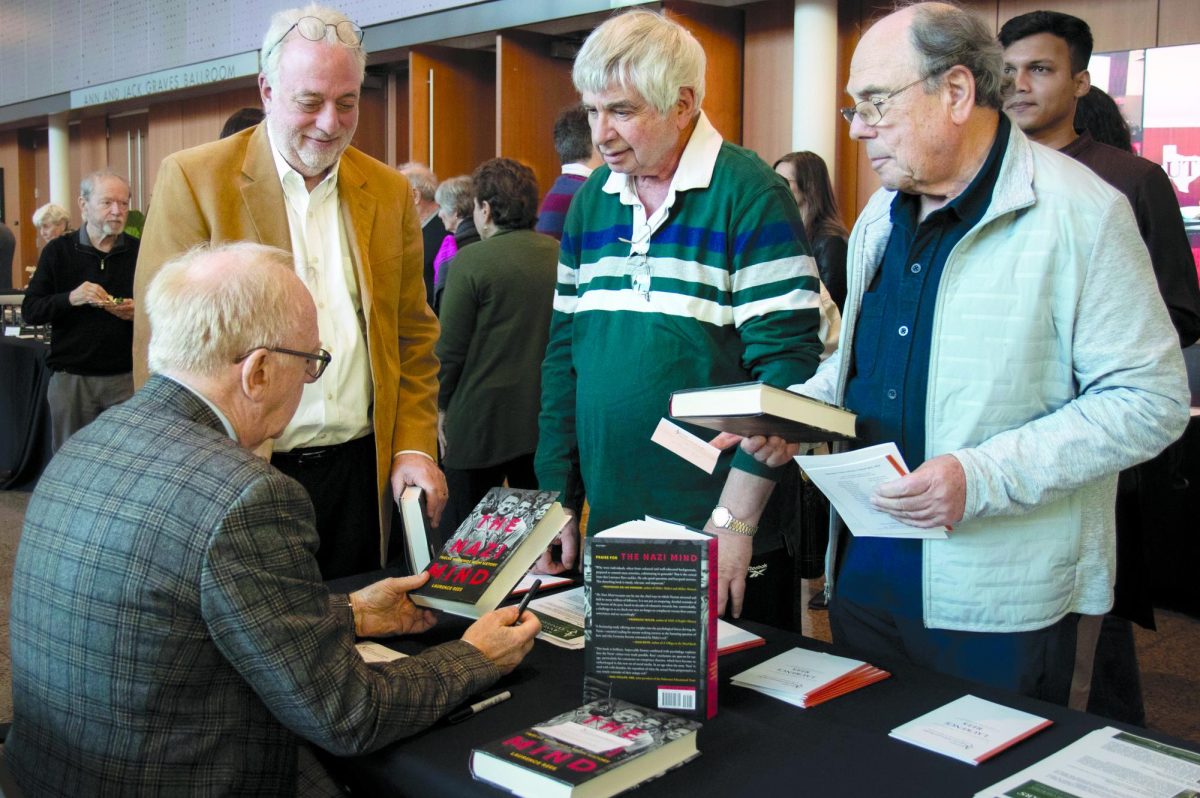
The annual Einspruch Lectures on the Holocaust are one of the biggest marks on the calendar for the Ackerman Center for Holocaust Studies at The University of Texas at Dallas. On Sunday, Feb. 15 and Monday, Feb. 16, UTD students and the general public alike gathered to attend the event hosted by the Ackerman Center. This year’s speaker was Laurence Rees, who delivered two lectures, titled “The Nazi Mind: Warnings from History,” and “The Holocaust: Moments of Escalation.”
Dr. Zsuzsanna Ozsváth, who was the founder of the Ackerman Center and responsible for the Einspruch lectures at UTD, passed away on Feb. 6, 2026. She was remembered during the introduction to the lectures.
“We are indebted to this incredibly strong woman for all that she did,” said event coordinator Cynthia Seton-Rogers. The importance of Holocaust education was emphasized by all involved in the Einspruch Lectures.
“Holocaust ignorance and lack of knowledge… is almost as dangerous [as holocaust denial],” said Rees during the opening of the lecture.
Further to this, Seton-Rogers said that Ozsváth’s passing is a reminder that “we are running out of time in our ability to hear firsthand accounts about the Holocaust.” She added, “The center’s mission is to preserve memories and prevent the truths of the Holocaust from ever being forgotten.”
Dr. Nils Roemer, director of the Ackerman Center, said that education is not the sole benefit of the Einspruch Lectures.
“It also helps with putting [UTD] on the map and having people recognise us, more than maybe they would have done 20 or 30 years ago,” Roemer said.
Rees’ lectures at UTD follow the release of his latest book, “The Nazi Mind: Twelve Warnings from History,” which was first published in January 2025. His first lecture covered three of these warnings: “spreading conspiracy theories,” “using Them and Us” and “exploiting faith.” He emphasized his use of the word ‘warnings’ rather than lessons, and said, “I don’t think history has any lessons. I don’t believe history can have lessons because it’s not prescriptive.”
Rees has published many other books throughout his career, including “The Holocaust: A New History,” which the Daily Telegraph called “the finest single volume on the Holocaust ever written.” Throughout his career, Rees has achieved a British Book award, a BAFTA, a George Foster Peabody award, a Broadcasting Press Guild award, a Grierson award, a Broadcast award, two International Documentary awards and two Emmys, as well as honorary doctorates from the University of Sheffield and The Open University.
The Einspruch lectures were open to the public. The first lecture, on Sunday, Feb. 15 at 4 p.m, took place in the Davidson-Gundy Alumni Center, where refreshments were provided before and after the event. The second lecture occurred at noon on Monday, Feb. 16 in the Naveen Jindal School of Management’s executive dining room, where lunch was provided.
The endowment for the Einspruch Lectures, which financed the event, was created in 2002. Prior to this, lectures under that title had already existed for a couple of years, made possible by fundraising efforts. Roemer explained that the endowment has made it possible to invite speakers of their choosing to speak at the event and to advertise the event in order to spread this education further.

Roemer, who took on the responsibility of organising the Einspruch lectures following Ozsváth’s retirement, commended her role in making this endowment possible.
“She was very, very committed to this idea of… offering something that reflected her very unique experiences,” Roemer said.
Ozsváth, born July 2, 1931, was a Holocaust survivor. She founded the Holocaust Studies Program at UTD in 1986, which later became the Ackerman Center for Holocaust Studies. Born in Békéscsaba, Hungary, she was able to survive the Holocaust by moving to Budapest,where she was persecuted and forced to live in the ghetto houses, as Jews in the capital were not deported to Auschwitz.
In an interview at the Sixth Floor Museum at Dealey Plaza, Dallas, in 2017, Ozsváth said that her move to the U.S. was due to increased job opportunities in America for scientists as a result of the Cold War. Ozsvath’s husband was one of these scientists, and the two moved to Austin in 1962.
“We came to Dallas which was a wonderful move. We had the most happy and wonderful life with the closest friends you can imagine,” said Ozsváth.
She also said that being at the university meant that she did not encounter any prejudice in Dallas, calling the academic environment “a bubble.”
Housed in the Erik Jonsson Academic Center on UTD’s campus, The Ackerman Center provides a space for those dedicated to studies of the Holocaust, genocide and human rights to read and work.
The Ackerman Center was closed on Feb. 6 out of respect for Ozsváth. Additionally, Roemer said that the center is in the process of looking for some feasible dates for a celebration of her life where as many of the people she affected as possible can participate. There is currently a link for those who wish to do so to leave a memorial gift on the UTD website.
