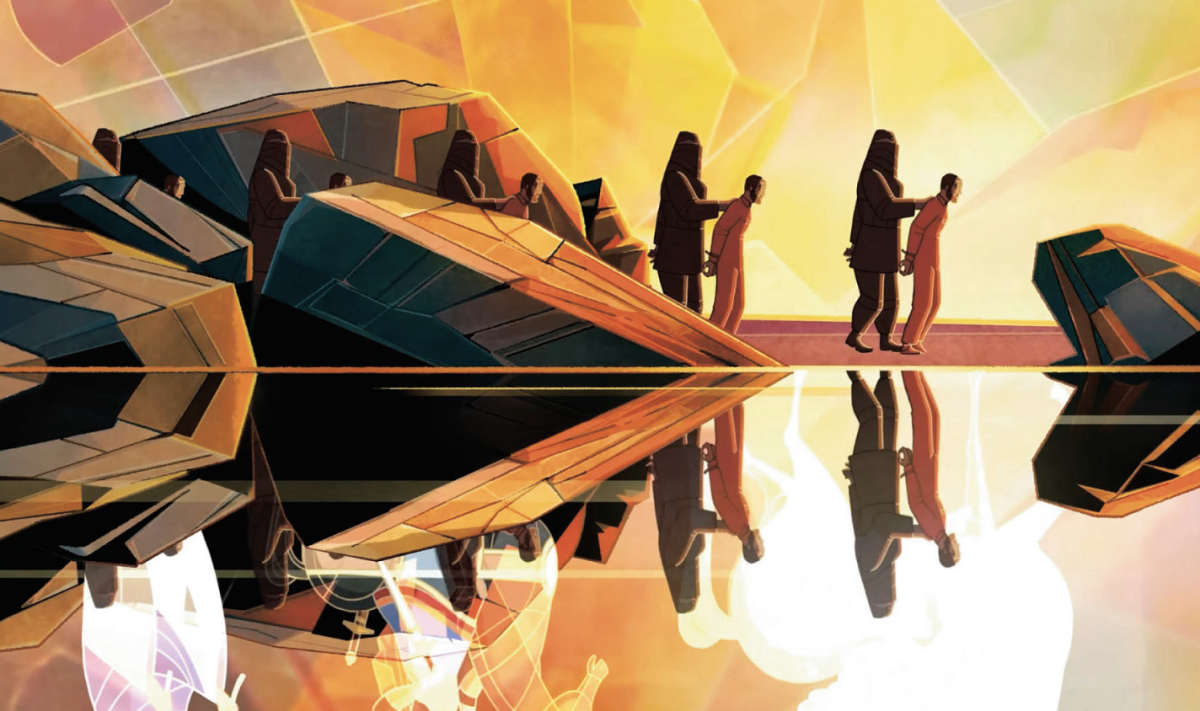
In 2015, 21 Coptic Christians were marched onto a Libyan beach in prison garb and told to renounce their faith or be killed. None of them recanted, and their deaths were filmed and aired online by the Islamic State group.
Tod Polson, an associate professor at the University of Texas at Dallas and a veteran animator, recently directed a short film titled “The 21,” which follows the events surrounding the massacre of the 21 Coptic Christian martyrs. The short film was screened on Nov. 18 at 6 p.m. in the Edith O’Donnell Arts & Technology Lecture Hall.
Polson said the project required a significant amount of research due to the sensitivity of the subject matter. The film took five years to produce, much of which was dedicated to gathering reliable testimony and verifying details. “We tried to be as accurate as possible. Again, all the information was from testimony,” Polson said.
In addition to traveling to Libya to see where the martyrs were held and tortured, the team interviewed the families of the martyrs and spoke with two former Islamic State soldiers.
According to Polson, the intention was to honor the martyrs and condemn extremism rather than further divide communities. UT Dallas speech, language and hearing sciences senior Samira Velazquez said, “It was not favoring one side, it depicted what happened. I think we’re all against violence.”
Polson collaborated with iconographers from Ukraine, which helped influence the Coptic iconography visual style used in the film. He said “The 21” incorporates neo-Coptic iconography to reinforce its spiritual foundation.
According to the Coptic Church, iconography is used to express God’s connection to the world and icons are often rooted in Scripture that invite viewers to contemplate the divine.
Polson said the film also drew inspiration from stained glass windows, illuminated manuscripts and precisionism, blending these influences into a unique and stylized depiction. He said each artistic depiction carried deep symbolic meaning tied to the martyrs’ faith.
Layout artist and UT Dallas professor Frederick Gardner explained that many backgrounds contain subtle cross imagery, facial features are intentionally stylized to evoke Christ and the compositional lines draw on principles of sacred geometry.
This film was crowdfunded and many animators volunteered their time. Gardner was one of these volunteers. “Rarely do you have an opportunity in this career to do something that’s pure art and also is a part of history,” Gardner said.
The production team consists of artists from Asia, Africa, North America, South America and Europe. Polson believes that the film’s unifying message against violence, along with the sincerity of the martyrs’ story, drew so many animators to the project.
“The 21” aims to serve as an important reminder of the past for those who watch it. Adetirele Adekanye, an animation and games sophomore said, “That’s the whole point of Christianity… to forgive.”
According to Polson, this short film is not intended to pit ideas or faiths against each other, but rather to serve as a work of art that is wholeheartedly anti-extremist.